
1.Why Traditional Budgeting Fails (and Why This Works)
Most people start a budget with high energy. They track every single ₹5 spent on tea. By day 10, they are exhausted and quit.
I’ve been there. I used to think I needed to be a math genius to save money. Then I found the 50/30/20 Rule. It’s not about restricting yourself; it’s about allocating your freedom. Think of it as a “Financial GPS.” You don’t need to know every turn; you just need to know the destination.
2. What Exactly is the 50/30/20 Rule? (The Pizza Analogy)
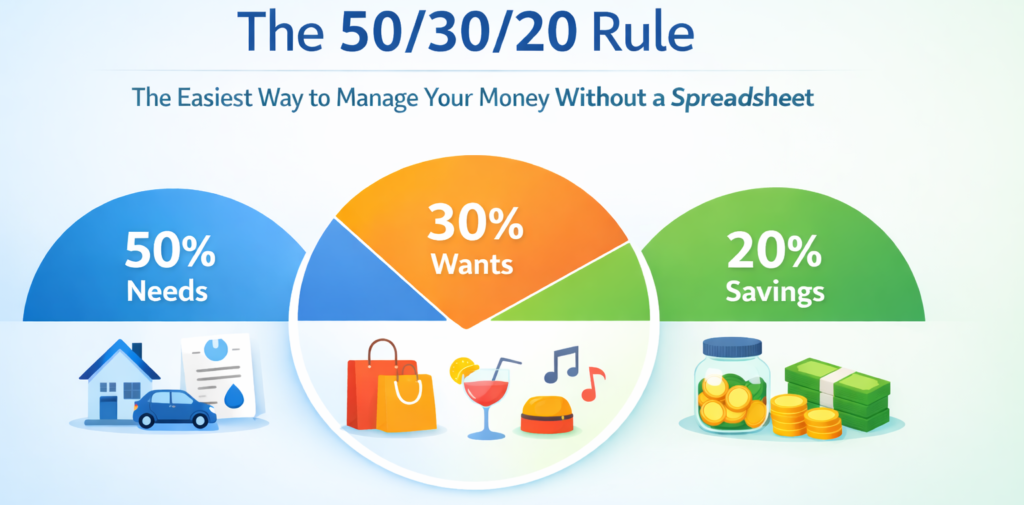
Imagine your monthly take-home salary is a large pizza. Instead of eating it randomly, you slice it into three specific portions:
- 50% (The Crust – Needs): The foundation that holds everything together.
- 30% (The Toppings – Wants): The stuff that makes life delicious.
- 20% (The Box – Savings/Debt): The part that protects the pizza and ensures you have more tomorrow.
3. Detailed Breakdown: Section by Section
Category 1: The 50% for “Needs” (The Essentials)
These are the bills you must pay to survive. If you don’t pay these, your life changes drastically.
- Rent or Home Loan (EMI)
- Groceries & Basic Food
- Electricity, Water, and Internet
- Insurance (Life and Health)
- Minimum Debt Payments
Infobuddy Tip: In India, our “Needs” can sometimes cross 50% because of high rent in cities like Mumbai or Bangalore. If your Needs are at 60%, don’t panic. Take 10% away from your “Wants,” NOT your “Savings.”
Category 2: The 30% for “Wants” (The Lifestyle)
This is where most people feel guilty, but the 50/30/20 rule gives you permission to spend here.
- Dining out & Ordering from Zomato/Swiggy
- Netflix, Prime, and Spotify Subscriptions
- Shopping for clothes (not uniforms)
- Hobby classes or Gym memberships
- Travel and Vacations
The Reality Check: A “Want” is something you could live without if things got tough. You don’t need that ₹250 coffee, but it makes your morning better. That’s a 30% item.
Category 3: The 20% for “Financial Goals” (The Wealth Builder)
This is the most important slice. This money doesn’t belong to your present self; it belongs to your future self.
- Building an Emergency Fund (as discussed in our Roadmap to Financial Freedom)
- Mutual Fund SIPs
- Extra Debt Repayment
- Retirement Funds (EPF/PPF)
4. Interactive Comparison: The “Messy” Budget vs. The 50/30/20 Budget
| Feature | The “Messy” Way (Common) | The 50/30/20 Way (InfoBuddy) |
| Spending Priority | Spend first, save what’s left | Save first (20%), then spend |
| Mental Stress | Constant guilt when buying shoes | No guilt, as long as it’s in the 30% |
| Emergency Prep | Zero or very low | Built-in via the 20% |
| Wealth Growth | Slow and accidental | Automatic and consistent |
5. How to Start if You Are Living Paycheck to Paycheck
If you are starting from zero, the 20% savings might look impossible. The “Step-Up” Strategy: Start with 60/35/5. Save just 5% this month. Next month, cut one “Want” (like one dinner out) and move to 60/30/10. Within 6 months, your goal is to hit that 20% mark.
6. Common Myths About the 50/30/20 Rule
Myth 1: It’s only for high earners. Fact: It’s actually more important for low earners to avoid debt traps.
Myth 2: It doesn’t work with Indian families. Fact: We have a natural culture of saving, but we often forget the “Wants” section, leading to “frugality burnout.” This rule balances it.
7. FAQs: Things My Readers Ask Me

Hi, I’m Sonu Kumar Pal, I write for InfoBuddy. I have completed my post graduation in Marketing & Finance from Gurugram and BBA from Patna.
I have been working in the marketing field for the last 8 years. I have hands-on experience in Meta Ads, Google Ads, performance marketing, lead generation, SEO, and business automation.
Along with my work, I have a strong interest in finance, stock market, and understanding how money decisions impact people and businesses.
Through InfoBuddy, I share simple and practical knowledge of both marketing and finance to help students and professionals make better decisions in their career, business, and daily life.