
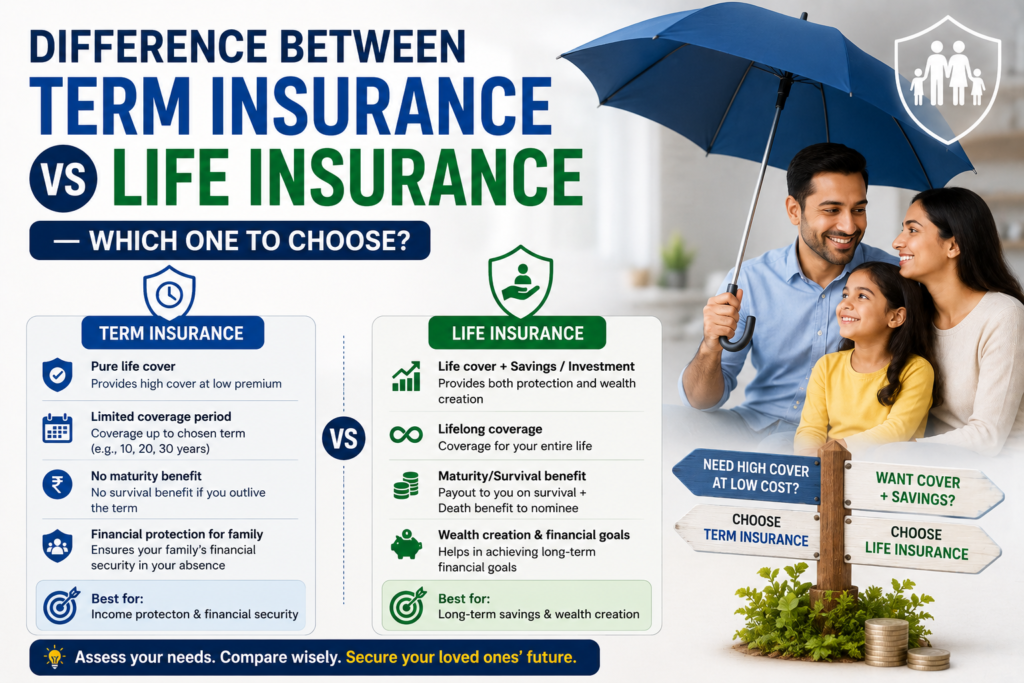
Term Insurance vs Life Insurance

Difference between Term Insurance vs Life Insurance โ€” Which one to choose?

๐Ÿ›ก๏ธ Financial Planning
“I have seen families go through financial devastation after losing their primary earner โ€” not because they had no insurance, but because they had the wrong kind. A โ‚น5 lakh traditional life insurance policy is not a financial safety net. It is a false sense of security. This guide is the conversation I wish more people had before they signed on the dotted line.” โ€” Anshuman Kumar, FP&A Manager & Finance Expert, InfoBuddy
Who this is for: Anyone who has been approached by an insurance agent, received a call about a “money-back plan,” or simply wants to understand the difference between term insurance and life insurance โ€” and make the right choice for their family.

The insurance agent sits across from you. He slides a brochure across the table. “Sir, this plan gives you life cover and returns your money if nothing happens.” It sounds perfect. You pay premiums for 20 years, your family is protected, and you get your money back. What could be wrong?

Quite a lot, actually.

The confusion between term insurance and “life insurance” โ€” meaning traditional endowment or money-back plans โ€” has cost millions of Indian families adequate financial protection. This guide breaks it all down clearly so you can make an informed decision, not an emotional one.

The Short Answer First

If you need to protect your family’s financial future in case something happens to you, term insurance is almost always the better choice. It gives you the highest cover for the lowest cost. Traditional life insurance plans do both โ€” insurance and investment โ€” and end up doing neither particularly well.

Now let us understand why, with actual numbers.

What is Term Insurance?

Term insurance is the simplest form of life insurance. You pay a premium every year for a fixed period โ€” say 30 years. If you die during that period, your family receives the sum assured (the cover amount). If you survive the term, the policy ends and you receive nothing back.

That last sentence makes people uncomfortable. “I pay for 30 years and get nothing if I survive?” Yes. And that is exactly why it is so powerful โ€” and so affordable.

Because the insurer is only paying out in the event of death, the premium is dramatically lower than traditional plans. A โ‚น1 crore cover for a 30-year-old non-smoker costs roughly โ‚น8,000โ€“โ‚น12,000 per year in term insurance. The same cover in a traditional endowment plan would cost โ‚น3โ€“5 lakhs per year.

What is Traditional Life Insurance?

Traditional life insurance โ€” also called endowment plans, whole life plans, or money-back plans โ€” combines insurance with a savings or investment component. You pay higher premiums, part of which goes toward your insurance cover and part goes into a savings fund. At the end of the policy term, you receive a maturity amount โ€” your premiums back, plus some returns.

It sounds like the best of both worlds. The reality is more nuanced.

Side-by-Side Comparison

๐Ÿ›ก๏ธ
Term Insurance
Pure protection โ€” nothing more
PurposePure life cover
Premium (โ‚น1Cr cover)โ‚น8Kโ€“โ‚น12K/year
Maturity benefitNone
Death benefitFull sum assured
Investment returnsNot applicable
Recommended forMost salaried Indians
๐Ÿ’ผ
Traditional Life Insurance
Insurance + savings combined
PurposeCover + savings
Premium (โ‚น1Cr cover)โ‚น3Lโ€“โ‚น5L/year
Maturity benefitPremiums + returns
Death benefitSum assured
Investment returns4โ€“6% p.a. typically
Recommended forSpecific situations only

The Numbers That Change Everything

The most powerful way to understand this comparison is to look at what happens to the money you save by choosing term insurance over a traditional plan.

Term Insurance
โ‚น10,000
Annual premium for a 30-year-old
Cover: โ‚น1 Crore for 30 years
Traditional Endowment
โ‚น3,50,000
Annual premium for same cover
Cover: โ‚น1 Crore for 30 years

The difference in annual premium: โ‚น3,40,000 per year. Over 30 years, that is โ‚น1.02 crore in “savings” just from choosing term insurance and investing the difference.

If you invest that โ‚น3,40,000 annually in a Nifty 50 index fund at 12% returns:

StrategyAfter 10 YearsAfter 20 YearsAfter 30 Years
Term + Invest the differenceโ‚น59.8Lโ‚น2.53 Crโ‚น9.4 Cr
Traditional endowment planโ‚น38Lโ‚น90Lโ‚น1.8 Cr
Difference+โ‚น21.8L+โ‚น1.63 Cr+โ‚น7.6 Cr
โš ๏ธ
The “money-back” illusion: A traditional plan returning โ‚น1.8 crore after 30 years sounds impressive. But inflation at 6% per year means โ‚น1.8 crore in 2054 is worth only about โ‚น30 lakhs in today’s money. The term + invest strategy producing โ‚น9.4 crore is worth about โ‚น1.55 crore in today’s terms โ€” still five times more.
๐Ÿ“– Real Example โ€” Two Brothers, Two Decisions

Rahul and Vikram, both 32, each earn โ‚น8 lakhs per year. Both want โ‚น1 crore of life cover for their families. Rahul buys a term plan for โ‚น11,000 per year and invests the remaining โ‚น3.39 lakhs annually in mutual funds. Vikram buys a traditional endowment plan for โ‚น3.5 lakhs per year, convinced by his agent that “the money comes back.”

Twenty years later, Vikram’s policy has a surrender value of โ‚น78 lakhs. Rahul’s mutual fund portfolio is worth โ‚น2.6 crores โ€” and his family has had โ‚น1 crore of life cover the entire time, just like Vikram’s. Vikram paid more. Got less. And still has no idea.

Types of Traditional Life Insurance โ€” Quick Overview

TypeHow It WorksBest For
Endowment PlanFixed premium for fixed term. Pays sum assured on death or maturity.Conservative savers who want guaranteed returns
Money-Back PlanReturns a percentage of sum assured at regular intervals during the policy term.Those who need periodic cash payouts
Whole Life PlanCover for entire lifetime (up to age 99/100). Higher premiums. Maturity at very old age.Estate planning, legacy transfer to children
ULIPs (Unit Linked)Part of premium invested in market-linked funds. Returns not guaranteed.Long-term investors comfortable with market risk โ€” though still not as efficient as term + mutual fund

When Does Traditional Life Insurance Actually Make Sense?

Term insurance is better for most people โ€” but traditional life insurance is not useless. There are specific situations where it makes sense:

1
You Cannot Be Trusted to Invest the Difference

This sounds harsh, but it is real. The term + invest strategy only works if you actually invest the premium difference consistently every year. If you know you will spend the savings instead of investing them, a traditional plan โ€” even at lower returns โ€” forces savings discipline.

The correct solution here is to automate your SIP so you cannot spend the money. But if that is not realistic for you, a traditional plan is better than no savings at all.

2
You Have a High-Risk Medical History

Term insurance premiums increase significantly โ€” or coverage may be denied โ€” if you have serious pre-existing conditions like diabetes, heart disease, or hypertension. In such cases, a traditional plan bought earlier (before the condition developed) may offer cover that term insurance no longer will.

This is one of the strongest arguments for buying term insurance young and healthy โ€” lock in the low premium before health conditions can affect eligibility.

3
Estate Planning and Legacy Transfer

For high-net-worth individuals looking to pass wealth to the next generation in a structured, tax-efficient way, whole life plans can be useful financial planning tools. This is a niche use case โ€” it does not apply to most salaried professionals.

Who Should Choose What?

๐Ÿ›ก๏ธ Choose Term Insurance If…
โœ…You are a salaried professional with dependants โ€” spouse, children, or parents who rely on your income
โœ…You have taken a home loan or any large liability that needs to be covered
โœ…You want maximum cover at minimum cost
โœ…You are willing to invest the saved premium separately in mutual funds
โœ…You are between 25 and 45 โ€” the ideal window to lock in low premiums
๐Ÿ’ผ Consider Traditional Life If…
๐Ÿ”ตYou have a specific savings goal tied to a deadline โ€” child’s education in exactly 15 years
๐Ÿ”ตYou need guaranteed, predictable returns and cannot tolerate market risk at all
๐Ÿ”ตYou have a pre-existing condition that makes term insurance expensive or unavailable
๐Ÿ”ตYou are doing estate planning with a financial advisor’s guidance

How Much Term Cover Do You Actually Need?

Most people are severely underinsured. A common rule of thumb: your cover should be 10 to 15 times your annual income.

Annual IncomeMinimum Cover (10x)Recommended Cover (15x)Approx Annual Premium
โ‚น5 Lakhsโ‚น50 Lakhsโ‚น75 Lakhsโ‚น6,000 โ€“ โ‚น8,000
โ‚น8 Lakhsโ‚น80 Lakhsโ‚น1.2 Croreโ‚น9,000 โ€“ โ‚น13,000
โ‚น12 Lakhsโ‚น1.2 Croreโ‚น1.8 Croreโ‚น13,000 โ€“ โ‚น20,000
โ‚น20 Lakhsโ‚น2 Croreโ‚น3 Croreโ‚น22,000 โ€“ โ‚น35,000

Also add your outstanding liabilities โ€” home loan, car loan, personal loans โ€” to this number. If you have a โ‚น40 lakh home loan and earn โ‚น8 lakhs, your cover should be at least โ‚น1.2 crore (income replacement) + โ‚น40 lakhs (loan) = โ‚น1.6 crore.

๐Ÿ’ก
InfoBuddy Tip: Buy term insurance as young as possible โ€” ideally between 25 and 35. A 30-year-old non-smoker pays roughly โ‚น10,000/year for โ‚น1 crore cover. The same policy at 40 costs โ‚น18,000โ€“โ‚น22,000/year. Every year you delay costs you money for the next 25โ€“30 years.

Top Term Insurance Providers in India โ€” 2026

InsurerClaim Settlement RatioKnown For
LIC Tech Term98.5%Highest trust, government-backed, slightly higher premium
HDFC Life Click 2 Protect98.8%Strong private insurer, good riders, online process
ICICI Prudential iProtect Smart97.8%Flexible rider options, good digital experience
Max Life Smart Secure Plus99.3%Highest claim settlement ratio among private insurers
Tata AIA Sampoorna Raksha98.5%Competitive pricing, strong brand
โ„น๏ธ
Claim Settlement Ratio (CSR) is the percentage of death claims an insurer paid out of all claims received in a year. A CSR above 97% is considered good. Always check the latest CSR from IRDAI’s annual report before buying.

Common Myths โ€” Busted

โŒ Myth
“Term insurance is a waste โ€” you get nothing if you survive”
โœ… Fact
Not getting the payout means you survived. That is the best outcome. The premium you paid was the cost of protecting your family โ€” like car insurance you hope never to claim.
โŒ Myth
“LIC is always the best โ€” it is government backed”
โœ… Fact
LIC is reliable, but several private insurers have higher claim settlement ratios. Compare CSR, premium, and features โ€” not just brand recognition.
โŒ Myth
“A โ‚น10โ€“20 lakh policy is enough for my family”
โœ… Fact
โ‚น20 lakhs lasts a family about 2โ€“3 years at modest living expenses. You need 10โ€“15x your annual income. For most salaried Indians, that is โ‚น75 lakh to โ‚น2 crore.
โŒ Myth
“I am young and healthy โ€” I do not need insurance yet”
โœ… Fact
Young and healthy is exactly when you should buy โ€” because your premiums will be the lowest they will ever be. Waiting until 40 to buy term insurance costs you tens of thousands of rupees over the policy lifetime.

Frequently Asked Questions

What happens to my term insurance if I stop paying premiums?
If you miss a premium payment, most insurers give a grace period of 30 days. If the premium is not paid within the grace period, the policy lapses and your cover stops. You can usually revive a lapsed policy within 2โ€“5 years by paying the outstanding premiums plus interest, subject to a medical examination.
Should I buy term insurance online or through an agent?
Online term plans are typically 20โ€“40% cheaper than the same plan bought through an agent, because there is no commission involved. The cover and claim settlement process are identical. Use comparison platforms like Policybazaar or the insurer’s website directly to buy online.
What riders should I add to my term insurance?
Three riders are worth considering: (1) Accidental Death Benefit โ€” doubles the payout if death is accidental, (2) Critical Illness Rider โ€” pays a lump sum if you are diagnosed with a serious illness like cancer or a heart attack, and (3) Waiver of Premium โ€” waives future premiums if you become permanently disabled. Do not over-load your policy with riders you do not need โ€” they add to the premium.
Is the term insurance premium tax deductible?
Yes. Term insurance premiums qualify for tax deduction under Section 80C of the Income Tax Act, up to a maximum of โ‚น1.5 lakhs per year. The death benefit paid to your nominee is also tax-free under Section 10(10D) โ€” subject to conditions.
Can I have both term insurance and a traditional life insurance policy?
Yes, and some people do. A common approach: buy adequate term cover first (primary protection), then add a small traditional plan if you have a specific forced-savings goal. Never buy a traditional plan as your primary insurance โ€” the cover is almost always insufficient.
What is the ideal term for a term insurance policy?
Your policy should ideally cover you until your youngest dependant becomes financially independent โ€” typically until your mid-60s. If you are 30 years old with a young child, a 30-year term (covering you to age 60) is a reasonable starting point. Longer terms mean slightly higher premiums but more comprehensive protection.

The question is not whether to get insurance. The question is whether to get the right kind.

Term insurance gives your family real financial protection at a cost that leaves room to also build wealth. Traditional life insurance gives you a combined product that does both jobs at a premium โ€” and typically does neither as well as doing each separately.

Buy term. Invest the difference. Revisit the decision every 5 years as your income and liabilities change.

The agent who sold your parents an endowment plan was not wrong for his time. But you have better options today โ€” and now you know what they are.

AK
Anshuman Kumar
FP&A Manager | MBA Finance, Bharti Vidyapeeth | 10+ Years in Financial Planning & Taxation
Anshuman is a Financial Planning & Analysis professional with over 10 years of hands-on experience in financial planning, budgeting, and compliance. He has worked extensively with individuals and organisations on financial risk management and insurance planning. He reviews and writes all financial content on InfoBuddy to ensure accuracy and real-world applicability for Indian readers.
Disclaimer: This article is for educational purposes only and does not constitute financial or insurance advice. Premium figures, returns, and claim settlement ratios are indicative and based on publicly available data as of 2026 โ€” actual figures vary by insurer, age, health condition, and policy terms. Always read the policy document carefully before purchasing any insurance product. InfoBuddy is not an IRDAI-registered insurance advisor. Please consult a licensed insurance advisor for personalised guidance.
Financial Disclaimer

The information provided on Difference between Term Insurance vs Life Insurance โ€” Which one to choose? by InfoBuddy is for educational and informational purposes only and should not be considered financial, investment, or legal advice.

We aim to simplify complex financial concepts, but we do not guarantee the accuracy, completeness, or reliability of any information presented. Financial decisions involve risk, and outcomes may vary based on individual circumstances, market conditions, and other factors.

Before making any financial or investment decisions, you should consult with a qualified financial advisor or a SEBI-registered investment advisor.

InfoBuddy and its authors, including Sonu Kumar Pal and contributors such as Anshuman Kumar, are not liable for any losses, damages, or financial decisions made based on the information provided on this website.

Leave a Comment

Your email address will not be published. Required fields are marked *