
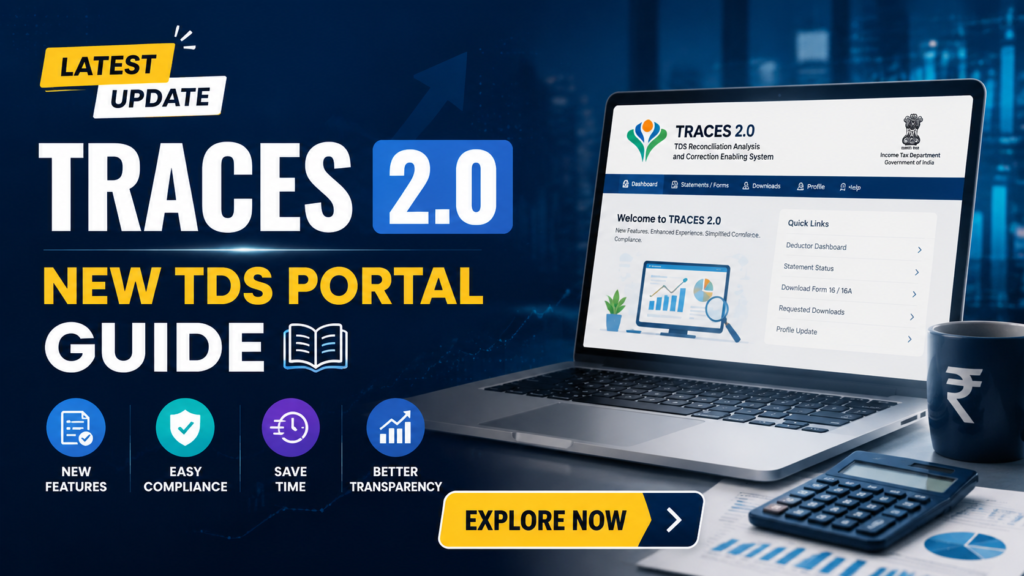
If you’ve ever been responsible for deducting tax at source (TDS) in India, you’re familiar with TRACES – the TDS Reconciliation Analysis and Correction Enabling System. It’s the go-to platform for everything related to TDS and TCS (Tax Collected at Source). Recently, the Income Tax Department rolled out a significant TRACES 2.0 update, integrating many functions directly into the unified e-filing portal.
This isn’t just a cosmetic change. It impacts how deductors and accountants manage their TDS responsibilities, offering a more streamlined and user-friendly experience. Understanding this TRACES 2.0 update is crucial for timely and accurate tax compliance. Moreover, it helps you avoid unnecessary errors or penalties, which is a major relief for any salaried individual juggling multiple financial responsibilities.
What is the TRACES 2.0 Update?
The TRACES 2.0 update represents the Income Tax Department’s move towards a more integrated and efficient tax ecosystem. Previously, TRACES (tdscpc.gov.in) operated as a separate portal for most TDS/TCS related services. Now, many of these crucial functionalities are being seamlessly integrated into the main Income Tax e-filing portal (incometax.gov.in).
This integration aims to provide a single window for all tax-related activities, from filing your ITR to managing TDS compliance. As a result, deductors can expect a more intuitive interface, improved data validation, and faster processing. It’s all about making your compliance journey smoother.
Key Features and Benefits of TRACES 2.0 for Deductors
The TRACES 2.0 update brings several improvements that can significantly benefit deductors and accountants:
- Unified Login: You no longer need separate credentials for TRACES and the Income Tax e-filing portal. A single login (using your PAN/TAN and password) now grants you access to both.
- Enhanced Dashboards: The new portal offers more comprehensive and interactive dashboards, giving you a clearer overview of your TDS/TCS activities, challan status, and statement processing.
- Real-time Data Validation: Expect improved validation checks during statement filing, which helps in reducing errors and ensuring accurate data submission from the get-go. This can save a lot of correction work later.
- Simplified Correction Process: The process for filing corrections to previously submitted TDS/TCS statements is now more streamlined, making rectifications less cumbersome.
- Improved Communication: The new system facilitates better communication and alerts regarding outstanding actions, notices, and updates from the Income Tax Department.
- Seamless Integration: Access various tax services, including ITR filing, Form 26AS/AIS viewing, and TDS/TCS related functions, all from one platform. This makes financial planning much easier.
Navigating the TRACES 2.0 Portal — A Step-by-Step Guide
Transitioning to a new system can be daunting. Therefore, here’s a simplified guide to help you perform common tasks on the TRACES 2.0 integrated platform:
Go to incometax.gov.in. Use your existing TAN and password to log in. If you don’t have an account, register as a ‘Deductor’ using your TAN.
After logging in, navigate to the ‘e-File’ section. Then, select ‘e-Pay Tax’ or ‘TDS/TCS’. You’ll find options for various TDS/TCS related services like ‘Download Form 26AS’, ‘View TDS/TCS credit’, ‘Upload TDS/TCS statement’, etc.
To request and download forms like Form 26AS or Consolidated File (Conso File) for corrections, look for the relevant options under the ‘e-File’ -> ‘Income Tax Forms’ or ‘TDS/TCS’ section. These are essential for reconciliation.
Prepare your TDS/TCS statement (Form 24Q, 26Q, etc.) using the latest utility. Then, upload it through the ‘e-File’ -> ‘Income Tax Forms’ -> ‘Upload TDS’ section. The portal will guide you through the submission process, including digital signature requirements.
Real Story — How a Freelance Consultant Simplified TDS with TRACES 2.0
Anjali Sharma, a freelance marketing consultant from Pune, often deducts TDS when paying her sub-contractors for graphic design or content writing services. Before the TRACES 2.0 update, managing these deductions, filing statements, and generating Form 16A for her contractors was a multi-step process involving two separate portals.
“I remember spending hours just trying to reconcile my challan payments with the TDS statements,” Anjali recalls. “Sometimes the data wouldn’t sync, and I’d get notices for minor mismatches. It was always a source of stress, especially at quarter-ends.”
With the TRACES 2.0 update, Anjali found the unified login a huge relief. She could now log in once to the Income Tax portal, check her Form 26AS as a deductee, and then switch to her role as a deductor to upload statements. The improved dashboard gave her a clear picture of her challan balances and filing status. “The real-time validation is a game-changer,” she says. “It catches small errors right away, preventing bigger issues later. I estimate I save about 4-5 hours each quarter on TDS compliance alone, which I can now dedicate to client work. It’s a noticeable improvement, especially for someone running a small operation.”
TRACES 2.0 Best Practices: Do’s and Don’ts
To ensure a smooth experience with the new TRACES 2.0 system, keep these essential practices in mind. Following these simple guidelines will help you stay compliant and avoid common pitfalls.
- Verify PAN/TAN details of deductees/deductors carefully.
- Reconcile TDS payments with challans regularly.
- Keep digital signatures (DSC) updated for quick e-filing.
- Maintain accurate records of all TDS transactions and challans.
- Utilise the ‘View Default Summary’ to identify and rectify errors promptly.
- Don’t delay filing your TDS/TCS statements; adhere to deadlines.
- Don’t share your login credentials with unauthorised individuals.
- Don’t ignore discrepancy notices from the Income Tax Department.
- Don’t rely on outdated software utilities for statement preparation.
- Don’t assume everything is correct without cross-checking your Form 26AS.
Frequently Asked Questions About TRACES 2.0 Update
The TRACES 2.0 update marks a significant step towards modernising tax administration in India. For salaried individuals, accountants, and small business owners who handle TDS, this integration aims to simplify compliance, reduce errors, and save valuable time. By understanding the new features and adopting the best practices outlined in this guide, you can confidently navigate the new TDS portal. Ultimately, staying updated with such changes is essential for maintaining sound financial health and compliance.
Remember, proactive management of your TDS responsibilities, combined with the capabilities of TRACES 2.0, will ensure a much smoother tax journey. So, embrace the change and make your tax compliance stress-free!