📋 Tax & Compliance
⏰
Deadline: July 31, 2026 — 69 days remaining
ITR filing for FY 2025-26 (AY 2026-27) is already open. ITR-1 and ITR-4 forms are live on the Income Tax portal. The sooner you file, the sooner your refund arrives.
“Every year between May and July, I get the same calls from colleagues and friends — ‘bhai ITR kaise bharte hain?’ Most of them are salaried, have a Form 16, and owe either zero tax or are due a refund. Their ITR takes 20 minutes. Yet they wait until July 30, file in a panic, and sometimes make errors that take months to correct. This guide exists so you never have to make that call.”
— Anshuman Kumar, FP&A Manager & Finance Expert, InfoBuddy
Who this guide is for: Any salaried employee in India who needs to file ITR for FY 2025-26 (AY 2026-27) — whether you have already received your Form 16, are waiting for it, or have never filed an ITR before. Step-by-step, zero jargon.
Your Form 16 is either already in your inbox or arriving in the next few weeks. Your employer has been deducting TDS every month. The government has already processed most of your tax. Now you just need to file — tell the Income Tax Department what you earned, confirm the TDS already paid, and claim any refund you are owed.
For most salaried employees, this entire process takes 15–30 minutes online. No CA required. No complicated math. Just the right documents and the right form.
FY 2025-26 ITR — Key Dates to Remember
NOW
Filing Open
ITR-1 and ITR-4 portal already live. File now, get refund early.
Jul 31
Last Date
Zero penalty. All deductions available. Carry forward losses allowed.
Dec 31
Belated Return
₹1,000–₹5,000 penalty. Interest on tax due. Cannot carry forward losses.
Mar 31
Revised Return
New 2026 rule — extra 3 months to correct errors after original filing.
⚠️
New 2026 change: Budget 2026 extended the revised return deadline to March 31 (from December 31 earlier). This means if you file by July 31 and later discover an error, you have until March 31, 2027 to correct it — giving you 8 months of correction window. File now, correct later if needed.
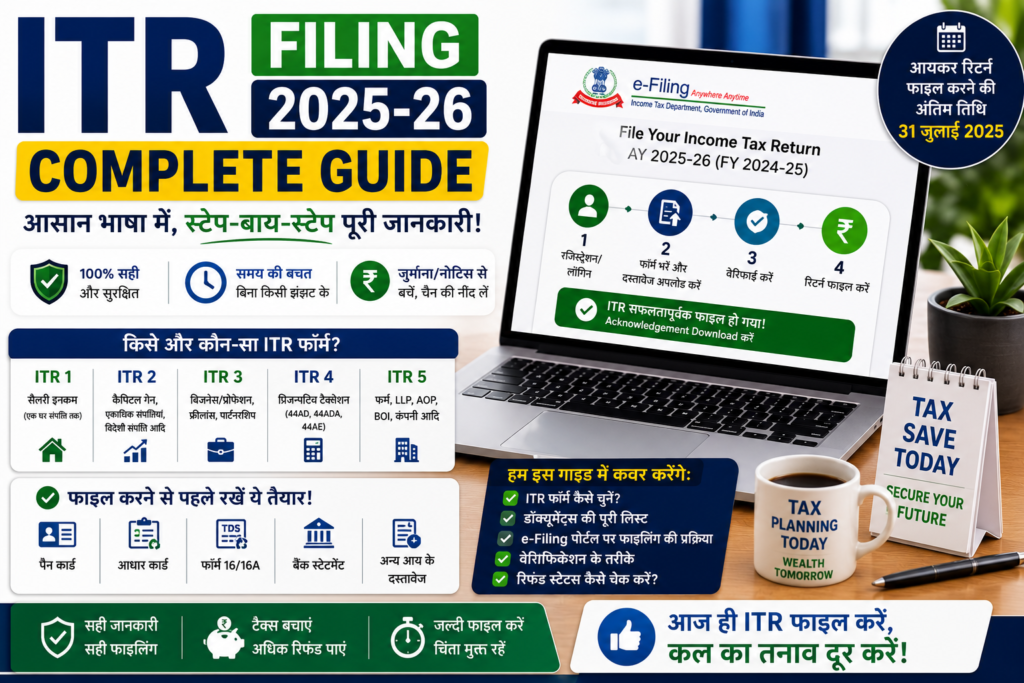
Which ITR Form Do You Need?
The single most confusing question for first-time filers. Here is the answer in plain terms:
💡
Simple rule: If you are salaried with only salary income + FD interest + maybe one home loan — use ITR-1. If you sold mutual funds or stocks in FY 2025-26 — use ITR-2. If you have any freelance or business income alongside your salary — use ITR-3. When in doubt, ITR-2 covers more scenarios than ITR-1 safely.
Documents You Need — Keep These Ready
Document Checklist — FY 2025-26 ITR Filing
📋 Identity & Basic
PAN card number (mandatory — filing impossible without it)
Aadhaar number linked to PAN (e-verification fails without this)
Bank account number + IFSC code for refund credit
Mobile number linked to Aadhaar (OTP for e-verification)
💼 Salary Documents
Form 16 — Part A (TDS deducted by employer) + Part B (salary breakup with deductions)
Salary slips for full year — especially if you changed jobs
Form 16 from previous employer (if job change during the year)
🏦 Income from Other Sources
Bank statements — interest earned on savings + FDs for all accounts
Form 26AS — tax credit statement (download from income tax portal)
Annual Information Statement (AIS) — shows all transactions reported against your PAN
Capital gains statement — if you sold mutual funds or stocks (available from broker)
📊 Deductions (Old Regime only)
80C proof — PPF passbook, ELSS statement, LIC premium receipt, home loan principal certificate
Home loan interest certificate from bank (Section 24b)
Health insurance premium receipt (Section 80D)
Education loan interest certificate (Section 80E)
How to File ITR Online — Step by Step
1
Login to the Income Tax Portal
Go to incometax.gov.in → Login → Enter your PAN number as the user ID → Enter password → Complete OTP verification on your registered mobile number.
First time user? Register with your PAN, Aadhaar, and mobile number. The portal auto-fetches most of your data from Form 26AS, AIS, and your employer’s TDS returns.
2
Check Your Form 26AS and AIS First
Before filling anything, download and check: Form 26AS (e-Filing portal → View Form 26AS) and AIS (Annual Information Statement). These show exactly what the government already knows about your income and TDS.
💡
Why this matters: If your Form 26AS shows TDS of ₹42,000 but your Form 16 says ₹45,000, there is a mismatch. File with the Form 26AS figure — not Form 16. Mismatches cause ITR processing delays and notices.
3
Select the Right ITR Form and Assessment Year
e-Filing portal → File Income Tax Return → Assessment Year: 2026-27 → Filing Type: Original → Mode of Filing: Online → Select ITR Form (ITR-1 for most salaried).
⚠️
Common mistake: Selecting the wrong Assessment Year. For income earned from April 2025 to March 2026, the Assessment Year is 2026-27. Not 2025-26. This mistake causes the entire filing to go to the wrong year and needs correction.
The new tax regime is the default from FY 2023-24. If your employer deducted TDS under the new regime, select new regime. If you have significant deductions (home loan, 80C investments, HRA) and informed your employer for old regime TDS — select old regime.
Not sure which regime saves you more tax? Use our Income Tax Calculator — Old vs New Regime comparison to check both scenarios with your exact numbers before you file.
You can switch regimes at this stage if your employer used the wrong one — the ITR will recalculate and either show additional tax due or a higher refund accordingly.
5
Fill or Verify Pre-filled Data
The portal auto-fills most fields from your Form 16, Form 26AS, and AIS. Review each section carefully — salary, other income, TDS deducted, deductions claimed. Correct anything that does not match your documents.
Add any income your employer may not know about — bank interest, FD interest, rent received — under “Income from Other Sources.” To understand your complete salary breakup and what income to declare, our Salary / CTC Calculator shows every component clearly.
6
Compute Tax — Pay Any Dues or Note Your Refund
The portal calculates your total tax liability vs TDS already paid. Three outcomes possible:
- Zero balance: TDS exactly matches liability — proceed to submit
- Tax due: Pay using Challan 280 online (Net Banking / UPI) before submitting
- Refund due: Submit the return — refund credited to your pre-validated bank account within 7–45 days
7
Submit and e-Verify — This Step Is Mandatory
Submitting the ITR is not enough. You must e-verify within 30 days of filing or the return is considered invalid. Three easiest ways:
- Aadhaar OTP — instant, easiest — requires Aadhaar linked to mobile
- Net Banking — login to your bank’s net banking and verify from there
- DEMAT account — if you have a demat account with CDSL or NSDL
After successful e-verification, you receive an Acknowledgement Number (ITR-V) — save this. It confirms your filing is complete and accepted.
📖 Real Example — Vikram’s ₹28,000 Refund That Almost Expired
Vikram, a 31-year-old HR executive in Hyderabad, had TDS of ₹38,000 deducted by his employer during FY 2024-25. His actual tax liability after claiming HRA exemption and 80C investments was only ₹10,000. He was owed a refund of ₹28,000.
He kept delaying. July 31 passed. He filed a belated return in November — paid ₹5,000 late filing fee under Section 234F. His refund of ₹28,000 arrived in February — four months after it could have arrived in August had he filed on time. The delay cost him ₹5,000 in penalties and 6 months of waiting for his own money.
For FY 2025-26, Vikram filed in June — the moment his employer released Form 16. His ₹31,000 refund arrived in 18 days. Same person, same job, completely different outcome — the only variable was the date he filed.
What Happens If You Miss the July 31 Deadline?
| Scenario | Penalty / Consequence | Section |
|---|
| Filed by July 31, 2026 | Zero penalty. All benefits available. | — |
| Belated return: Aug 1 – Dec 31 | ₹5,000 late fee (₹1,000 if income below ₹5L) | 234F |
| Tax due but not paid | 1% per month interest on unpaid tax | 234A |
| TDS short paid during year | 1% per month on short deduction amount | 234B / 234C |
| Not filed at all (income above ₹2.5L) | Notice under Section 142(1) + potential prosecution | 139 / 142 |
| Cannot carry forward losses | Capital loss, business loss cannot offset future gains | 139(1) |
✅
New 2026 rule — good news: Even if you file after July 31 (belated return), you can now carry forward certain losses under the updated Income Tax Act 2025. Earlier this was completely prohibited for belated returns. However, filing on time still remains far better — no penalty, full deduction benefits, faster refund.
Common ITR Filing Mistakes — Avoid These
❌ Wrong
Selecting Assessment Year 2025-26 for income earned in FY 2025-26
✅ Right
FY 2025-26 income is filed in AY 2026-27. Assessment Year is always the year AFTER the financial year.
❌ Wrong
Not declaring FD interest because “the bank already deducted TDS so it is settled”
✅ Right
TDS is only 10% advance tax. If your slab is 20–30%, you owe the balance. FD interest must always be declared. Use our
FD Calculator to estimate your annual interest income.
❌ Wrong
Filing but skipping e-verification because “the return is submitted”
✅ Right
Filing WITHOUT e-verification is an invalid return. You must e-verify within 30 days. No e-verification = treated as not filed.
❌ Wrong
Not filing ITR because “my employer already deducted TDS and I owe nothing”
✅ Right
Filing ITR is compulsory if income exceeds ₹2.5L regardless of TDS. Plus — you may be owed a refund you will never receive without filing.
Who Must File ITR — Quick Reference
| Situation | Must File? | Reason |
|---|
| Income above ₹2.5 lakhs (old regime) | Yes — mandatory | Basic exemption limit exceeded |
| Income above ₹3 lakhs (new regime) | Yes — mandatory | Basic exemption limit exceeded |
| TDS deducted but income below limit | Yes — to claim refund | Cannot get refund without filing |
| Sold mutual funds or stocks (any amount) | Yes — mandatory | Capital gains must be reported |
| Have foreign assets or foreign income | Yes — mandatory regardless of income | FEMA + IT Act compliance |
| Want to apply for home loan / visa | File even if not mandatory | ITR is key document for loans and visas. See our CIBIL Score Guide — ITR helps build credit profile |
🔗 Useful Tools for Your ITR Filing
Frequently Asked Questions
I changed jobs in FY 2025-26. How do I file ITR?
Collect Form 16 from both employers. Combine the total income and TDS from both Form 16s. File ITR-1 if the total income is below ₹50 lakhs and there are no capital gains — declare salary from both employers under “Salary” section. The portal’s pre-filled data usually captures both if both employers have filed TDS returns correctly. Cross-check with Form 26AS to confirm all TDS is reflected.
My income is below ₹12.75 lakhs and I owe zero tax. Do I still need to file?
Legally, if your income exceeds ₹3 lakhs (new regime) or ₹2.5 lakhs (old regime), filing is mandatory even if tax is zero. Additionally, even if you are below these limits, filing is strongly recommended if you had TDS deducted on FD interest or salary — otherwise you cannot claim the refund. An ITR is also required for home loan applications, visa applications, and as proof of income.
Can I file ITR without Form 16?
Yes. Form 16 is not mandatory for filing — it is just a convenient summary document. You can file using your salary slips (to determine gross salary and deductions), Form 26AS (to check TDS deducted), and the AIS (Annual Information Statement) from the tax portal. If your employer has filed TDS returns correctly, most data will be pre-filled on the portal even without Form 16.
How long does it take to get an ITR refund?
For returns filed early (April–June) with e-verification completed within 24 hours — refunds typically arrive in 7–21 days. For July filings, 20–45 days is typical. Refunds are credited directly to your pre-validated bank account. Early filing consistently results in faster refunds — the portal processes earlier filings before the July rush. Check refund status at incometax.gov.in under “e-File → Income Tax Returns → View Filed Returns.”
I filed an ITR with a mistake. What should I do?
File a revised return. Under the updated 2026 rules, you can file a revised return up to March 31, 2027 for AY 2026-27 — an extension from the earlier December 31 deadline. Go to the portal → File Return → Filing Type: Revised → Select the original return → Make corrections → Submit and re-verify. The revised return supersedes the original. There is no penalty for filing a revised return as long as it is within the deadline.
Should I use ClearTax / Groww Tax / CA or file directly on the portal?
For most salaried employees with straightforward income — one employer, some FD interest, standard 80C deductions — filing directly on incometax.gov.in is perfectly adequate and free. Third-party platforms like ClearTax or myITReturn simplify the interface and are useful for first-timers or those with multiple income sources. A CA is recommended only if you have business income, capital gains from stocks, foreign income, or if your ITR is selected for scrutiny.
July 31 sounds far away. It is not. Form 16s arrive in June. The portal is already live. Early filers get refunds in July. Late filers pay penalties in December and wait until January for money the government has owed them since April.
Open incometax.gov.in this week. Download your Form 26AS and AIS. Keep your Form 16 ready. File ITR-1. E-verify with Aadhaar OTP. Done in 20 minutes.
Your tax refund — if you are owed one — is sitting in a government account right now, earning no interest for you. The only thing between you and that money is a 20-minute online form.
AK
Anshuman Kumar
FP&A Manager | MBA Finance, Bharti Vidyapeeth | 10+ Years in Financial Planning & Taxation
Anshuman Kumar is a Financial Planning & Analysis professional with over 10 years of experience in Indian taxation, TDS compliance, payroll, and ITR filing. He has guided hundreds of salaried professionals through ITR filings across multiple assessment years. He writes and reviews all tax and compliance content on InfoBuddy to ensure accuracy for Indian salaried taxpayers.
Disclaimer: This guide is for educational purposes only based on the Income Tax Act 2025 and CBDT notifications current as of May 2026. Tax laws, deadlines, and forms are subject to change by government notification. ITR deadlines may be extended by CBDT — always verify final dates at incometax.gov.in. The information here is general in nature — individual tax situations vary based on income sources, residential status, and applicable deductions. Please consult a qualified Chartered Accountant for personalised tax advice. InfoBuddy is not a registered tax advisor or CA firm.