
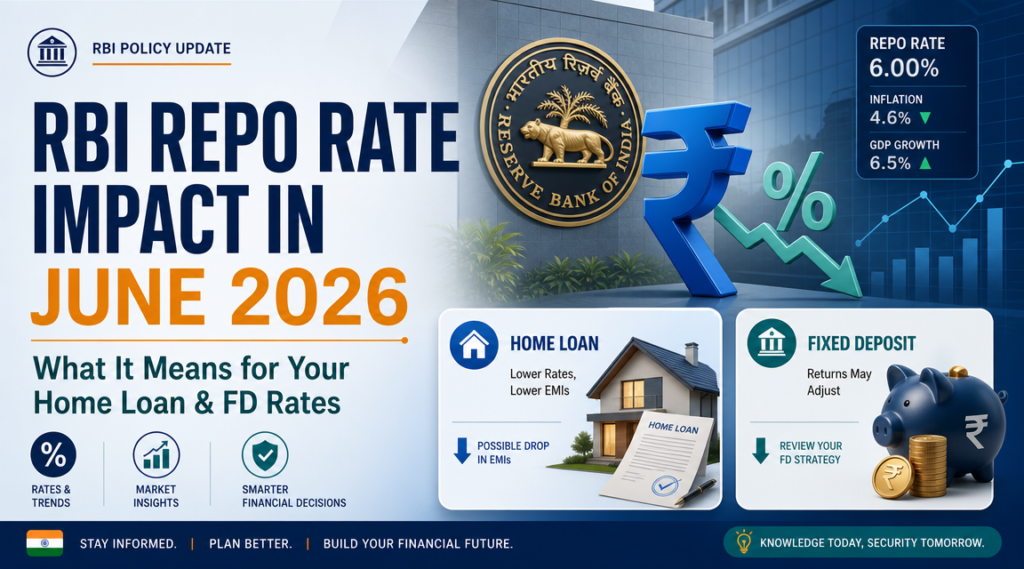
Ever wondered what happens behind those closed doors at the Reserve Bank of India (RBI)? Every few months, the Monetary Policy Committee (MPC) meets, and their decisions, particularly on the repo rate, create ripples across the entire Indian economy. Moreover, these ripples directly affect your personal finances, whether you’re paying EMIs or earning interest.
The upcoming RBI MPC meeting in June 2026 is one such crucial event. Many salaried individuals keenly await the outcome to understand its potential RBI Repo Rate Impact on their monthly budgets. Therefore, knowing how these changes translate into real money in your pocket or out of it is essential for smart financial planning.
This comprehensive guide will break down the repo rate’s mechanism and explain its direct implications for your home loans and Fixed Deposits. Furthermore, we will help you prepare for any shifts announced by the RBI.
Decoding the RBI Repo Rate Impact on Your Finances
The repo rate is essentially the interest rate at which the Reserve Bank of India lends money to commercial banks in India. It’s a powerful tool used by the RBI to control inflation and manage the country’s money supply. When banks need funds, they borrow from the RBI at this rate.
Consequently, this cost of borrowing for banks influences the interest rates they, in turn, offer to their customers – both on loans and deposits. A higher repo rate makes borrowing more expensive for banks, which then passes on this increased cost to you in the form of higher loan interest rates. Conversely, a lower repo rate makes borrowing cheaper.
The Monetary Policy Committee (MPC) is a six-member body responsible for determining the policy interest rates required to achieve the inflation target. Moreover, their decisions are keenly watched by markets and individuals alike. This is because every decision has a widespread RBI Repo Rate Impact.
For example, if the RBI increases the repo rate, banks will face higher borrowing costs. Therefore, they will likely increase their own lending rates for customers, leading to higher EMIs for existing loans and new loans. Similarly, they might offer higher interest rates on Fixed Deposits to attract more funds. Knowing this linkage is your first step towards financial preparedness.
Please verify the latest announcements at rbi.org.in as rules and rates may have changed since this publication.
How RBI Repo Rate Changes Your Home Loan EMIs
For most salaried Indians, a home loan is one of the biggest financial commitments. The RBI Repo Rate Impact on your home loan EMI is direct and significant, especially if your loan is linked to an external benchmark.
Since October 2019, the RBI mandated that all new floating rate retail loans, including home loans, must be linked to an external benchmark. The repo rate is the most common external benchmark (EBLR). Previously, loans were linked to MCLR (Marginal Cost of Funds based Lending Rate) or base rate.
When the RBI changes the repo rate, banks usually adjust their External Benchmark Lending Rate (EBLR) shortly after. For instance, if the repo rate increases, your bank’s EBLR will also likely increase. Consequently, the interest rate on your floating home loan will go up, leading to a higher monthly EMI.
Conversely, if the RBI reduces the repo rate, your EBLR would decrease, resulting in lower interest rates and reduced EMIs. However, remember that your home loan interest rate is EBLR plus a spread (margin) set by the bank. This spread usually remains constant throughout your loan tenure.
You can easily calculate how a change might affect you using our Home Loan EMI Calculator.
Steps to Understand Your Home Loan’s Linkage to Repo Rate
Your loan agreement clearly states whether your home loan is linked to the repo rate (EBLR), MCLR, or another benchmark. This is the first step to understanding its sensitivity to RBI changes.
Even if your loan is linked to EBLR, the interest rate adjustment might not be immediate. Banks typically have a reset period (e.g., every 3 months, 6 months, or annually) after which your EMI changes.
Keep an eye on RBI Monetary Policy announcements. These are widely reported in financial news. Knowing the decision empowers you to anticipate EMI changes.
Once you know your benchmark and the RBI’s decision, use an EMI calculator to estimate how much your monthly payment might change. This helps in budgeting effectively.
RBI Repo Rate Impact on Your Fixed Deposit (FD) Returns
While the focus is often on loans, the RBI Repo Rate Impact extends significantly to your savings instruments, particularly Fixed Deposits. FDs are a popular choice for many salaried Indians seeking stable, guaranteed returns.
When the RBI increases the repo rate, it generally signals a tightening of monetary policy. In such scenarios, banks often raise their lending rates, but they also tend to increase their deposit rates, including those for Fixed Deposits, to attract more funds. This is because they need to pay more to the RBI for borrowings, so they offer more to depositors to manage their liquidity.
Conversely, if the RBI lowers the repo rate, it’s typically to encourage borrowing and stimulate economic growth. During such times, banks might reduce their FD interest rates. This makes FDs less attractive and encourages investors to look for other avenues, potentially riskier but higher-returning ones.
It’s important to note that FD rate changes might not be as immediate or direct as home loan rates. Banks also consider other factors like their own liquidity needs, competitive landscape, and overall credit demand when setting FD rates. However, the repo rate remains a primary indicator.
To see how different rates can affect your savings, check out our FD Calculator.
A Real Story: Priya’s Home Loan Journey with RBI Repo Rate Changes
Priya, a 30-year-old software engineer working in Bengaluru, bought her first apartment in 2022. She took a home loan of ₹50 Lakhs from a leading bank, with her interest rate explicitly linked to the RBI’s External Benchmark Lending Rate (EBLR) plus a 2% spread. Her initial interest rate was 7.5% per annum, and her EMI was around ₹37,163.
In mid-2023, the RBI, aiming to curb inflation, hiked the repo rate by 50 basis points (0.50%). Priya initially didn’t think much of it, but after her bank’s quarterly reset, her interest rate jumped to 8.0%. Consequently, her EMI increased to ₹38,590 – an extra ₹1,427 every month. This had a notable RBI Repo Rate Impact on her budget.
Priya was initially concerned, as this unexpected increase put a strain on her monthly expenses. However, instead of panicking, she proactively reviewed her loan statement and used an online EMI calculator to understand the impact precisely. She then decided to increase her monthly EMI by a small, affordable amount (₹500) and also planned to make a small lump-sum prepayment whenever she received her annual bonus. This strategy helped her mitigate the increased burden and stay on track with her financial goals, all thanks to understanding the repo rate mechanism.
When the RBI hiked the repo rate, Priya’s home loan EMI of ₹37,163 (at 7.5%) increased to ₹38,590 (at 8.0%). This unexpected rise of ₹1,427 pushed her to understand the RBI Repo Rate Impact better. Instead of solely bearing the higher cost, she adjusted her budget and proactively planned small prepayments to manage the increased financial outflow effectively.
Do’s and Don’ts for Salaried Indians During RBI Repo Rate Shifts
Navigating the financial landscape during periods of RBI repo rate changes can feel daunting. However, with a clear strategy, you can minimize negative impacts and even find opportunities. Here’s a quick guide:
Frequently Asked Questions About RBI Repo Rate Impact
The Reserve Bank of India’s repo rate decisions are not just abstract economic news. They have a tangible and often significant RBI Repo Rate Impact on the everyday finances of salaried Indians. From the EMI you pay on your home loan to the returns you earn on your Fixed Deposits, the repo rate is a fundamental driver.
As we approach the June 2026 MPC meeting, understanding the potential outcomes and their implications is your best defense against financial surprises. By staying informed, reviewing your financial products, and taking proactive steps, you can effectively manage your money and make smarter decisions, regardless of how the repo rate moves. Always remember, financial awareness is your strongest asset.