
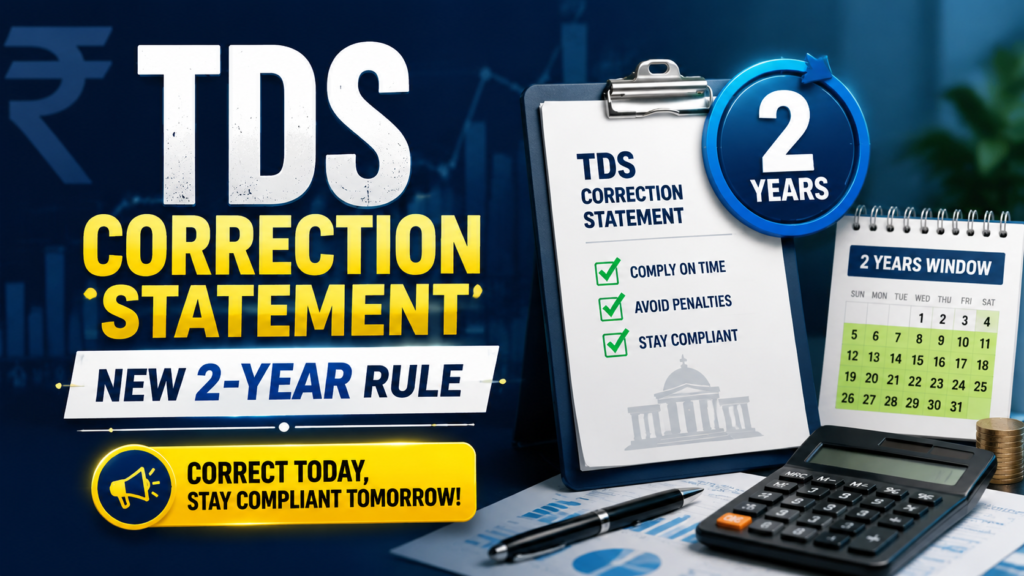
Have you ever noticed a mismatch in your Form 26AS or faced an issue with your employer’s TDS deductions? Previously, you had a decent window of 6 years to rectify these errors by filing a **TDS Correction Statement**. However, a major change is coming that will drastically shorten this period. This new rule, introduced by the Finance Act 2025 and amended by the CBDT, reduces the correction window to just 24 months. Understanding this new **TDS Correction Statement** deadline is crucial for every salaried individual in India.
As salaried professionals, we often rely on our employers to handle TDS correctly. But sometimes, mistakes happen – a wrong PAN entry, an incorrect amount, or even a misclassified section. These errors can lead to delays in income tax refunds or, worse, notices from the tax department. Therefore, knowing how to file a **TDS Correction Statement** and adhering to the new timeline becomes extremely important.
Understanding the New TDS Correction Statement Deadline
Let’s get straight to the critical update. Until recently, if there was an error in your TDS details, your employer (or the deductor) could file a TDS Correction Statement to rectify it for up to 6 years from the end of the financial year in which the original TDS statement was filed. This provided ample time to sort out discrepancies. Nevertheless, this is no longer the case.
As a result of this CBDT amendment, once the new rule comes into effect from April 1, 2026, any TDS Correction Statement for an original statement filed on or after this date will only be allowed within 24 months. For instance, if your employer files a TDS statement for Q1 FY 2026-27 (April-June 2026) in July 2026, any correction to this statement must be made by July 2028. This is a significantly shorter timeframe.
Why This 24-Month Window Matters for Your Taxes
This revised timeline for filing a TDS Correction Statement has direct implications for your financial planning and tax compliance. Firstly, it demands greater promptness from both deductors (like your employer) and deductees (you) in identifying and rectifying any TDS-related issues. Secondly, it reduces the buffer you had for discovering and fixing long-standing errors.
Moreover, accurate TDS reporting ensures that your tax credits are correctly reflected in your Form 26AS. Any discrepancy can directly impact your income tax refund process. Therefore, a shortened correction window means you must be more proactive. You need to verify your Form 26AS regularly to catch any mismatches early. This will allow your employer sufficient time to file the necessary TDS Correction Statement.
Steps to Ensure Timely TDS Reconciliation
Make it a habit to view your Form 26AS at least twice a year, if not quarterly. This document reflects all TDS deducted against your PAN.
Compare the TDS amounts shown in your Form 26AS with your monthly salary slips and the Form 16 issued by your employer. Ensure all figures align.
If you find any discrepancy, inform your employer’s HR or finance department without delay. They are responsible for filing the TDS Correction Statement.
Once you’ve reported an error, follow up to ensure the correction is made and reflected in your Form 26AS within the new 24-month window.
Common Reasons for Needing a TDS Correction Statement
There are several scenarios where a TDS Correction Statement becomes necessary. Being aware of these common pitfalls can help you avoid them or address them quickly when they occur. Understanding these allows you to be proactive.
- Incorrect PAN: Perhaps the most common error. If your PAN is incorrectly mentioned by the deductor, the TDS credit won’t reflect in your Form 26AS.
- Wrong Amount: The deducted amount might not match the amount deposited by the deductor. This directly impacts your tax liability.
- Incorrect Financial Year/Assessment Year: Sometimes, TDS might be attributed to the wrong financial year, causing issues during ITR filing.
- Wrong Section/Nature of Payment: Though less common for salaried individuals, misclassification of TDS sections can happen.
- Duplicate Entries: If the same TDS entry is made twice, it can cause confusion.
Real Story: How Rajesh from Bengaluru Navigated a TDS Mismatch
Rajesh, a software engineer living in Bengaluru, discovered a significant mismatch in his Form 26AS for FY 2025-26. His employer had mistakenly deducted ₹1,20,000 as TDS but only uploaded ₹1,00,000 to the income tax portal. The missing ₹20,000 meant his tax credit was short.
He noticed this in February 2028, just a few months before the new 24-month deadline (assuming his Q4 FY25-26 TDS was filed in July 2026). Rajesh immediately flagged it to his company’s HR. Because he was proactive, his company was able to file the necessary TDS Correction Statement by March 2028, reflecting the full ₹1,20,000 in his Form 26AS. If he had waited, say, till August 2028, the new rule would have made it impossible to correct, leaving him liable for the ₹20,000 discrepancy.
Do’s and Don’ts for Your TDS Filings
Frequently Asked Questions About TDS Correction Statements
The new 24-month limit for filing a **TDS Correction Statement**, effective April 1, 2026, marks a critical shift in tax compliance. As salaried Indians, it’s now more important than ever to be proactive and vigilant about your TDS details. Regularly checking your Form 26AS and communicating promptly with your employer about any discrepancies will help you navigate this change smoothly.
Staying informed and acting quickly ensures your tax records are accurate, saving you from future hassles and penalties. Make this a priority in your financial routine to avoid any last-minute surprises.