
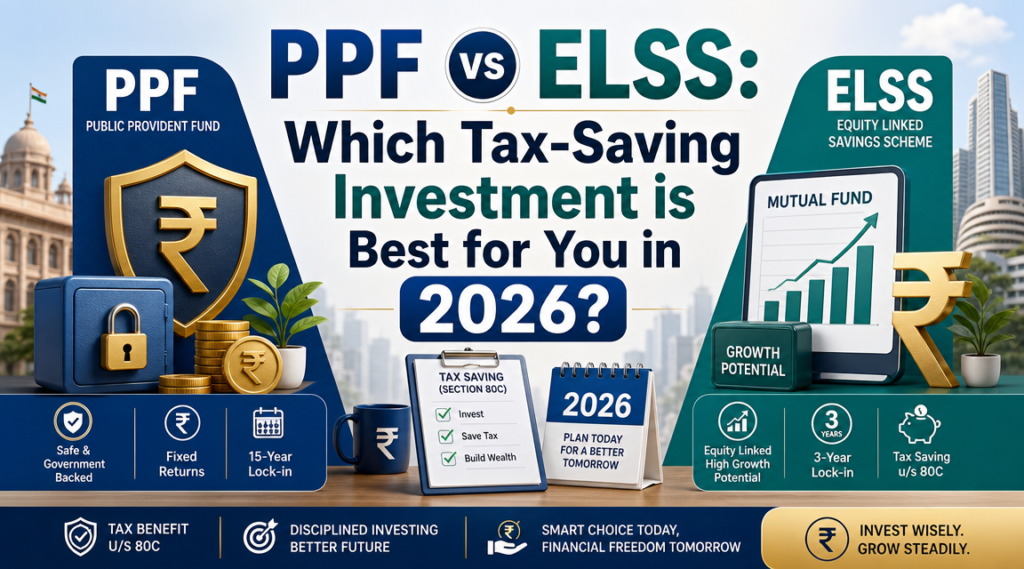
PPF vs ELSS: Which Tax-Saving Investment is Best for You in 2026?
Navigating the world of tax-saving investments can feel like solving a complex puzzle. Every year, you likely wonder how to best save on taxes while also growing your money. Two popular options often come up in discussions: the Public Provident Fund (PPF) and Equity Linked Savings Schemes (ELSS).
Both PPF and ELSS allow you to claim deductions under Section 80C of the Income Tax Act, 1961. This means you can reduce your taxable income by investing up to ₹1.5 lakh annually. However, they are fundamentally different investments, suited for different financial profiles. Understanding these differences is key to making the right choice for your money goals.
Let’s dive deep into PPF vs ELSS to see which one aligns better with your financial aspirations for 2026 and beyond. This comparison will help you decide where to put your hard-earned money.
PPF vs ELSS: The Core Differences You Need to Know
When you’re comparing PPF vs ELSS, it’s essential to look beyond just the tax-saving aspect. These two instruments offer very different characteristics in terms of returns, risk, and liquidity. Understanding these core differences will help you make an informed decision for your investment portfolio.
As you can see from the highlights, the choice between PPF and ELSS hinges on several factors. Your personal financial goals and how much risk you are comfortable taking play a significant role. Let’s examine each option in more detail to help you decide.
Public Provident Fund (PPF): Safety First for Your Savings
The Public Provident Fund (PPF) has been a favourite tax-saving instrument for generations of Indians. It’s a government-backed scheme, meaning your capital and returns are extremely safe. You can open a PPF account at most public and private banks, as well as post offices across India.
The interest rate for PPF is declared quarterly by the government. Currently, the PPF interest rate stands at 7.1% per annum, compounded annually. This rate is reviewed regularly, but it offers a guaranteed return, which is a major comfort for many investors.
Key Features of PPF
- Long Lock-in: PPF comes with a long lock-in period of 15 years. While partial withdrawals are allowed after 7 years, the full maturity is 15 years. You can extend it in blocks of 5 years after maturity.
- Section 80C Benefit: Your contributions up to ₹1.5 lakh per financial year are eligible for deduction under Section 80C. This is a significant tax benefit for salaried individuals.
- EEE Status: PPF enjoys the coveted Exempt, Exempt, Exempt (EEE) tax status. This means your contributions, interest earned, and maturity amount are all tax-exempt.
- Loan Facility: You can avail a loan against your PPF balance from the third to the sixth financial year from account opening.
Guaranteed Returns: The biggest advantage is capital safety and guaranteed, tax-free returns. You know exactly what you’ll get.
Risk-Free: Being a government scheme, PPF carries zero market risk. Your investment is protected from market volatility.
Tax-Free Growth: The EEE status makes it an excellent tool for long-term wealth creation without any tax deductions on returns.
Financial Discipline: The long lock-in period encourages disciplined, long-term saving. This can be beneficial for retirement planning.
Long Lock-in: The 15-year lock-in can be restrictive if you need funds sooner. Your money is tied up for a considerable period.
Lower Returns: While guaranteed, PPF returns are often lower compared to equity-linked investments like ELSS. It might not beat inflation significantly.
Limited Contribution: You can only invest a maximum of ₹1.5 lakh per financial year. This caps your tax-saving and growth potential.
No Exposure to Equity: If you are looking for higher returns and have a higher risk appetite, PPF won’t provide exposure to the stock market’s growth potential.
PPF is ideal for conservative investors who prioritize safety and assured returns. It’s also a great foundation for any long-term financial plan, especially for retirement.
ELSS (Equity Linked Savings Scheme): Aiming for Higher Growth
ELSS, or Equity Linked Savings Schemes, are a type of diversified equity mutual fund. Unlike PPF, ELSS funds invest a major portion of your money (typically over 80%) into the stock market. This means their returns are linked to market performance, offering the potential for higher growth but also carrying market risk.
Historically, ELSS funds have delivered average annual returns in the range of 11-14% or even more over long periods. However, these are not guaranteed returns; they fluctuate with market conditions. Therefore, you must be prepared for potential ups and downs in your investment value.
Key Features of ELSS
- Shortest Lock-in for 80C: ELSS has the shortest lock-in period among all Section 80C investments, at just 3 years. This provides relatively better liquidity.
- Section 80C Benefit: Like PPF, your investments up to ₹1.5 lakh per financial year qualify for Section 80C deduction.
- Market-linked Returns: Your investment grows with the stock market. This offers the potential for significant wealth creation over the medium to long term.
- Taxation of Returns: Returns from ELSS are subject to Long Term Capital Gains (LTCG) tax. Gains up to ₹1 lakh in a financial year are tax-exempt. Gains exceeding ₹1 lakh are taxed at 10% without indexation.
Higher Return Potential: ELSS has the potential to deliver inflation-beating returns, significantly growing your wealth over time. This is a major draw for many.
Short Lock-in: The 3-year lock-in is very attractive, especially compared to other 80C options. This offers greater flexibility.
Equity Exposure: It’s an excellent way to gain exposure to the equity market. This is crucial for long-term wealth creation for most individuals.
Professional Management: Your money is managed by experienced fund managers. They make investment decisions on your behalf. Therefore, you do not need to research stocks yourself.
Market Volatility: The biggest con is the market risk. Your returns are not guaranteed and can be volatile. This requires a strong stomach.
LTCG Tax: While gains up to ₹1 lakh are exempt, anything above that is taxed at 10%. This can eat into your higher returns.
No Capital Protection: There is no capital protection, unlike PPF. You could potentially lose money if the market performs poorly.
Requires Monitoring: While professionally managed, it’s good practice to periodically review your ELSS fund’s performance. This ensures it aligns with your goals.
Real Story: Priya’s Tax-Saving Journey with PPF vs ELSS
Priya, a 30-year-old software engineer in Bengaluru, earns ₹1.2 lakh per month. She had ₹1 lakh to invest for tax saving under Section 80C. Priya was torn between PPF and ELSS. She had heard about the high returns of ELSS but was also concerned about market risks.
After consulting with a financial advisor, Priya decided on a hybrid approach. She allocated ₹50,000 to her PPF account to ensure a safe, long-term saving component for her future. For the remaining ₹50,000, she started a SIP in an ELSS fund. She was comfortable with some market risk for the potential of higher returns. By balancing safety and growth, Priya created a diversified tax-saving portfolio. She aims to achieve her financial goals by 2030, a mix of capital protection and wealth growth.
Making Your Choice: PPF vs ELSS in the New Tax Regime
The introduction of the New Tax Regime (NTR) has added another layer of complexity to tax planning. Under the New Tax Regime, you cannot claim deductions under Section 80C. This means investments in PPF or ELSS will not provide any tax benefits on the contribution amount if you opt for the NTR.
However, this does not mean PPF and ELSS lose their relevance entirely. For those who choose to stick with the Old Tax Regime (OTR), Section 80C deductions are still available. Therefore, PPF and ELSS remain excellent options for reducing your taxable income.
Why PPF & ELSS are Still Relevant (Even in New Tax Regime)
- For OTR Optants: If you are in the Old Tax Regime, PPF and ELSS are your primary tools for claiming Section 80C deductions up to ₹1.5 lakh. They are indispensable for tax planning.
- For NTR Optants (Investment Perspective): Even if you choose the New Tax Regime, PPF and ELSS are still solid investment products. PPF offers a guaranteed, tax-free return (EEE status) for long-term savings. ELSS provides exposure to equity and the potential for significant wealth creation with a short lock-in. They are good investments irrespective of tax deductions.
- Financial Discipline: Both schemes instill financial discipline through their lock-in periods. This helps you build a corpus over time.
Your choice should be based on your risk profile, liquidity needs, and financial goals. Consider whether you need tax deductions (OTR) or simply good investment avenues (NTR & OTR).
Frequently Asked Questions About PPF vs ELSS
Choosing between PPF vs ELSS for your tax-saving needs in 2026 ultimately depends on your individual financial landscape. If you prioritize absolute safety, guaranteed returns, and have a long-term horizon, PPF is your go-to. However, if you are comfortable with market fluctuations and seek higher, inflation-beating growth with a shorter lock-in, ELSS could be the better fit.
Remember, there’s no one-size-fits-all answer. Consider your risk appetite, liquidity requirements, and long-term financial objectives. Many successful investors find a middle ground by investing in both, leveraging the strengths of each. Make an informed decision that empowers your financial future.