
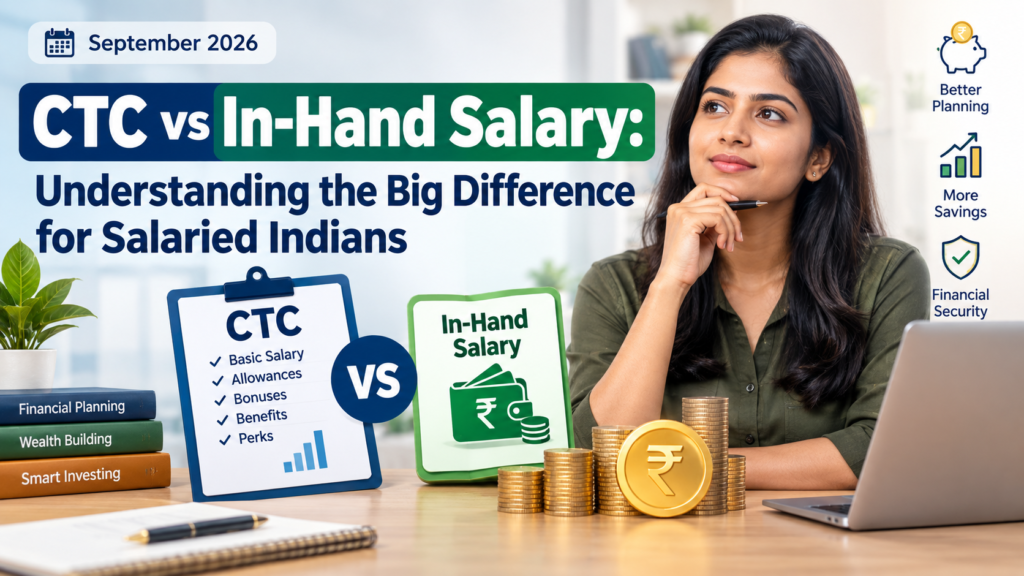
Priya is 28. She works as a marketing executive in Bangalore, with an annual CTC of ₹8 lakhs. That’s ₹66,667 every month. When she started her first job, she proudly told her parents about her high CTC.
She expected her monthly bank credit to be around ₹60,000. But when her first salary hit, it was just ₹48,000. Priya was shocked. “Where did the rest go?” she asked herself. She felt confused, almost cheated by the numbers. The big difference between her CTC vs In-Hand Salary was a rude awakening.
This kind of confusion is something I see all the time in my 10 years working with salaried clients. The promise of a large CTC can feel misleading if you don’t understand the full picture. Let’s break it down so you never face Priya’s dilemma.
What Exactly is CTC? (Cost to Company)
Your CTC, or Cost to Company, is the total expense your employer incurs for you in a year. Think of it as the entire package, not just the cash in your hand. It includes everything from your basic pay to benefits and statutory contributions.
Many components make up your CTC. Some are directly paid to you, while others are indirect benefits or contributions made on your behalf.
Components like Basic Salary, HRA, and Special Allowances usually form a large part of your direct pay. Employer contributions to Provident Fund (PF) and Gratuity are also part of your CTC, but they are not paid to you directly every month. Source: EPFO India — Verified May 2024
Your In-Hand Salary: The Money That Lands In Your Bank
Your In-Hand Salary, also known as Net Salary or Take-Home Pay, is the actual amount that gets credited to your bank account each month. This is the money you can spend or save immediately.
This amount is always less than your CTC. It is also often less than your gross salary (total pay before employee-specific deductions). Why? Because several deductions are made from your gross salary before it reaches your account.
| Component | Annual Amount (₹) | Monthly Amount (₹) | Notes |
|---|---|---|---|
| Gross Salary (Direct Pay) | 7,00,000 | 58,333 | Basic + HRA + Special Allowances |
| Less: Employee PF Contribution | 48,000 | 4,000 | Mandatory deduction |
| Less: Professional Tax | 2,400 | 200 | State-specific, max ₹2,500/year |
| Less: Income Tax (TDS) | 36,000 | 3,000 | Based on tax slab & declarations (FY 2024-25, AY 2025-26) |
| Less: Health Insurance (Employee share) | 6,000 | 500 | If applicable |
| Net In-Hand Salary | 6,07,600 | 50,633 | Your actual take-home pay |
As you can see, even from the direct pay component of your CTC, there are significant deductions. This is why knowing your estimated In-Hand Salary is crucial for accurate financial planning.
The Common Deductions Explained
Let’s look at the main culprits that reduce your take-home pay. Knowing these will help you understand your salary slip better.
1. Employee Provident Fund (EPF) Contribution
This is a mandatory retirement savings scheme. Both you and your employer contribute 12% of your basic salary (and Dearness Allowance, if applicable) to your EPF account. Your employer’s contribution is part of your CTC, but your contribution is deducted from your gross salary.
2. Professional Tax (PT)
This is a small tax levied by state governments in India. It varies from state to state and typically has a maximum limit of ₹2,500 per annum. It’s a small deduction, but it is a consistent one.
3. Income Tax (TDS)
Tax Deducted at Source (TDS) is your income tax deducted by your employer. They calculate your estimated annual tax liability based on your salary and any tax-saving declarations you submit (like 80C, HRA exemptions, etc.) and deduct a portion each month. This is then reflected in your Form 16.
Rahul’s Realization: How Understanding Made a Difference
Rahul is 30. He works as a marketing manager in Delhi, with an annual CTC of ₹10 lakhs. For years, he just saw the big CTC figure and assumed he was earning a lot. Still, he always felt short on cash by the 20th of every month. His actual take-home pay was only ₹68,000, not the ₹80,000 he roughly calculated in his head.
Last year, after reading one of our InfoBuddy articles, Rahul decided to sit down with his salary slip. He painstakingly itemized every deduction. He realized that nearly ₹12,000 per month was going towards employee PF, health insurance premiums, and TDS, which he hadn’t fully accounted for. “It was like finding ₹12,000 I didn’t know I was missing,” he told me.
This realization was a game-changer. Rahul stopped budgeting based on his gross pay. Instead, he started planning his expenses strictly based on his ₹68,000 in-hand salary. He felt more in control of his money. In fact, when he got a new job offer recently, he asked for a detailed breakup of the CTC. He negotiated for higher basic pay and less variable pay, ensuring his in-hand salary would be closer to his target.
Do’s and Don’ts When Looking at Your Salary
Which One Should YOU Choose? — A Simple Decision Guide
Understanding both CTC and In-Hand Salary is important. But for different purposes. Here’s how to decide which one to focus on at a given time:
Your Next Step — Do This Today
Don’t just read this and forget. Take action right now!
Frequently Asked Questions About CTC vs In-Hand Salary
Understanding the difference between CTC vs In-Hand Salary isn’t just about knowing numbers; it’s about gaining control over your finances. Your CTC reflects your total value to the company, but your In-Hand Salary is the real money you live on.
Take the time to scrutinize your salary slip. Know where every rupee goes. This knowledge will empower you to budget smarter, negotiate better, and ultimately, feel more confident about your financial situation. Don’t let your salary surprise you again.