
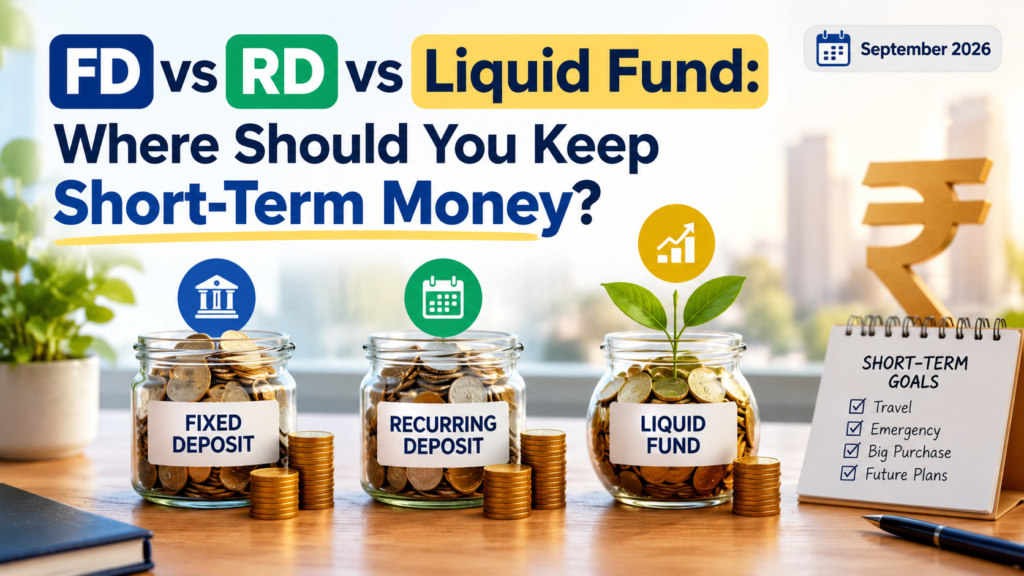
I’ve seen too many salaried Indians keep their important short-term money in a basic savings account. They think it’s safe and easily accessible. But what they don’t realise is that inflation is quietly eating away at their purchasing power every single day.
— Anshuman Kumar, FP&A Manager, InfoBuddy FinanceThis guide is for you if you are a salaried Indian, aged 25-42, and you have money set aside for emergencies, upcoming expenses, or a down payment in the next 1-3 years. You want to keep this money safe and accessible, but you also want it to work a little harder for you. We’ll compare FD, RD, and Liquid Funds to help you choose wisely.
Meet Rohan. He is 31, a software engineer in Bangalore, taking home ₹85,000 every month. For years, he kept his emergency fund of ₹3.5 lakhs in his savings account. He felt secure knowing it was always there.
Last year, his car needed unexpected repairs costing ₹60,000. He used his savings account. He was happy the money was available. But then he came to me for tax planning. We looked at his overall financial picture.
“Anshuman, I could have earned more on that ₹3.5 lakhs, right?” he asked. I showed him how much he lost by keeping his short-term money idle. Over 2 years, even a few percentage points difference could have added an extra ₹10,000-₹15,000 to his pocket. That’s money for a nice weekend trip, gone.
Why Short-Term Money Needs a Smart Home
Short-term money isn’t for long-term growth. It is money you will need in the next few months to three years. This could be your emergency fund (3-6 months of expenses), an upcoming home down payment, or a major purchase.
The goals for this money are very clear:
- Safety: You cannot afford to lose this money.
- Liquidity: You need access to it quickly, usually within a few days.
- Modest Returns: At least enough to beat inflation. You don’t want it to just sit there and lose value.
Now, let’s look at the popular options for your short-term money in India.
Fixed Deposit (FD): The Traditional Choice
A Fixed Deposit is perhaps the most well-known investment option for many Indians. You deposit a lump sum for a fixed period, and the bank pays you a fixed rate of interest.
What are FDs Good For?
- Guaranteed Returns: The interest rate is fixed at the time of deposit. It won’t change even if market rates fluctuate.
- Safety: Your principal is protected. Deposits up to ₹5 lakh per bank are covered by DICGC. Source: RBI — Verified July 2024
- Simplicity: It is easy to open and understand.
The Downsides of FDs
- Limited Liquidity: While you can break an FD prematurely, banks often levy a penalty, reducing your interest earnings.
- Taxation: Interest earned on FDs is fully taxable at your income tax slab rate. If interest exceeds ₹40,000 (₹50,000 for senior citizens), TDS is deducted. Source: Income Tax Department — Verified July 2024
- No Regular Savings: You need a lump sum to start.
Recurring Deposit (RD): Consistent Saving
A Recurring Deposit is like a systematic savings plan. You commit to depositing a fixed amount every month for a set period, and you earn interest on your contributions.
Why Consider RDs?
- Discipline: Forces you to save a fixed amount regularly. This is great if you are saving for a specific, future expense like an annual insurance premium or a festival gift.
- Guaranteed Returns: Like FDs, the interest rate is fixed when you start the RD.
- Low Minimum Amount: You can often start an RD with as little as ₹100 per month.
RD Challenges
- Lower Returns: Sometimes, RD rates are slightly lower than FD rates for similar tenures.
- Premature Withdrawal Penalty: Similar to FDs, breaking an RD early can incur penalties.
- Taxation: Interest earned is fully taxable at your slab rate, and TDS rules apply similar to FDs.
Liquid Funds: A Modern Solution for Short-Term Needs
Liquid funds are a type of mutual fund. They invest primarily in very short-term debt instruments like Treasury Bills, Commercial Papers, and Certificates of Deposit. The maturity period of these instruments is usually up to 91 days. Source: SEBI — Verified July 2024
The Power of Liquid Funds
- High Liquidity: You can usually withdraw your money within T+1 working day. Some offer instant withdrawal up to ₹50,000 via specific apps.
- Potentially Better Returns: Historically, liquid funds have often delivered returns higher than savings accounts and sometimes even short-term FDs, especially before tax.
- No Lock-in: You can invest or withdraw any amount at any time without penalty.
- Taxation (Post 3 Years): For investments held over 3 years, capital gains are taxed with indexation benefits, which can be more tax-efficient than FD interest.
What to Watch Out For with Liquid Funds
- Market Risk (Minimal): While considered very safe, they are not 100% risk-free like FDs. Their Net Asset Value (NAV) can fluctuate slightly.
- Not for the Uninformed: Requires a basic understanding of mutual funds.
- No Guaranteed Returns: Returns are market-linked and can vary daily, though usually stable.
| Feature | Fixed Deposit (FD) | Recurring Deposit (RD) | Liquid Fund |
|---|---|---|---|
| Investment Type | Lump sum | Regular monthly installments | Lump sum or SIP |
| Liquidity | Low (penalty for early withdrawal) Bad | Low (penalty for early withdrawal) Bad | High (T+1 day, sometimes instant) Good |
| Returns | Fixed, guaranteed | Fixed, guaranteed | Market-linked, variable (potentially higher than SA/FD) Neutral |
| Risk | Very Low (DICGC covered up to ₹5L) Good | Very Low (DICGC covered up to ₹5L) Good | Low (minimal market risk) Neutral |
| Taxation | Fully taxable at slab rate (TDS applicable) Bad | Fully taxable at slab rate (TDS applicable) Bad | Short-term: slab rate; Long-term (>3 yrs): indexation benefit Good |
| Best For | Parking lump sums for 6-24 months with certainty | Building savings discipline for specific short-term goals | Emergency fund, temporary parking for large sums, very short-term goals (0-12 months) |
Real Story: Priya’s ₹80,000 Dilemma
Priya is 30, a marketing executive in Mumbai. She earns ₹70,000 a month. Last year, she had saved up ₹80,000 for a vacation to Goa in 6 months. She kept the money in her savings account, earning a meagre 3.5% interest. She thought it was safe and accessible.
When she talked to me, I showed her how a liquid fund might have worked. If she had invested that ₹80,000 in a liquid fund, assuming an average return of 6.5% (post-expense ratio), she could have earned an extra ₹1,200 over those 6 months. It doesn’t sound like much, but it’s a difference of almost 50% more earnings compared to her savings account.
“It’s not about becoming rich,” Priya told me, “it’s about making my money work for me, even for small goals.” She moved her emergency fund and future short-term savings into a liquid fund. Now, she watches her money grow a little faster.
The Do’s and Don’ts of Short-Term Money Management
Which One Should YOU Choose? — A Simple Decision Guide
- You have a lump sum (e.g., ₹50,000+) to park.
- Your timeline is fixed, between 6 months to 2 years.
- You prioritise absolute certainty of returns.
- You are comfortable with potential premature withdrawal penalties.
- You want to save a small, fixed amount monthly (e.g., ₹1,000-₹10,000).
- Your goal is for a specific expense in 6 months to 3 years.
- You need disciplined savings and guaranteed returns.
- You anticipate no need for early access.
- This is your emergency fund, needing instant/quick access.
- You have money for very short-term goals (0-12 months).
- You are comfortable with minimal market fluctuations.
- You seek potentially higher returns than a savings account.
Your Next Step — Do This Today
Figure out 3-6 months of your essential expenses (rent, EMIs, groceries, utilities). This is the absolute minimum you need liquid. Takes 5 minutes.
Visit the websites of at least 3 banks (e.g., SBI, HDFC Bank, ICICI Bank) to check their latest FD and RD interest rates for your preferred tenure. Takes 10 minutes.
Go to AMFI India’s website to understand mutual funds. Then use a platform like Groww, Zerodha Coin, or Kuvera to research top-rated liquid funds based on expense ratio and historical returns. Takes 15 minutes.
Frequently Asked Questions
Choosing where to keep your short-term money doesn’t have to be complicated. The key is to match your financial goals with the right instrument. Whether it’s the security of an FD or RD, or the superior liquidity and potential returns of a Liquid Fund, there’s a solution out there for you.
Don’t let your hard-earned money sit idle. Make a conscious choice today and ensure your short-term savings are working as hard as you are.