
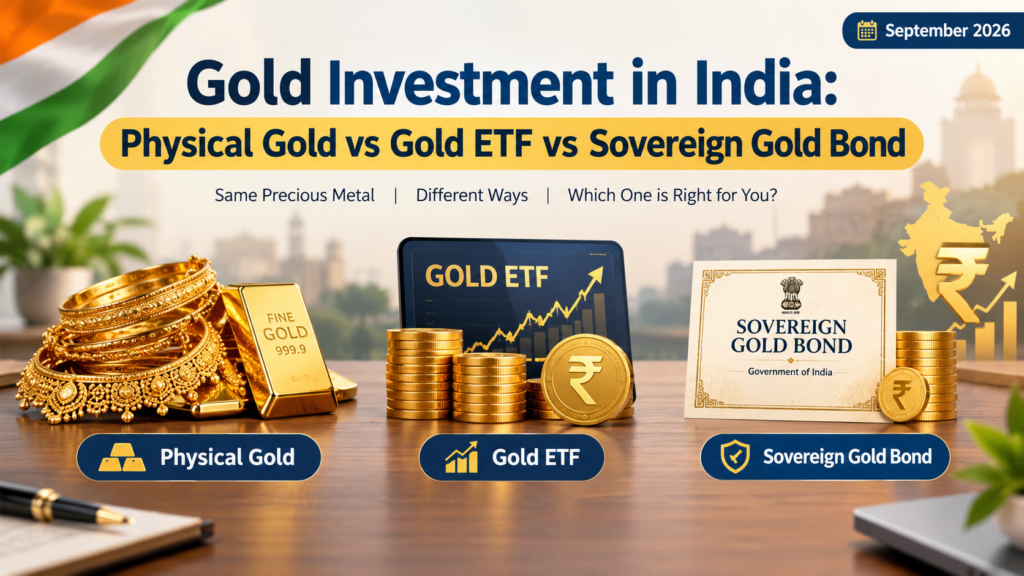
“Gold is deeply rooted in Indian culture. But for salaried individuals, just buying jewellery isn’t a smart investment. You need to understand the modern gold investment options available today to truly make your money grow.”
— Anshuman Kumar, FP&A Manager & Founder, InfoBuddy FinanceWho this guide is for: If you are a salaried Indian, perhaps between 28 and 45, and have always thought of gold as just jewellery or a family heirloom, this guide is for you. You want to invest in gold but are confused by options like Gold ETFs and Sovereign Gold Bonds. You need simple, clear answers to make an informed decision today.
Deepika, a 31-year-old marketing manager in Chennai, earning ₹65,000 a month, called me last month. Her grandmother had just gifted her ₹50,000 to “buy some gold.” Deepika felt confused.
“I usually put money in SIPs,” she told me. “But this is gold. Do I just buy a gold chain? What about these SGBs my uncle keeps talking about? Is a Gold ETF better?” She sounded genuinely overwhelmed.
Deepika’s confusion is common. For many of us, gold investment options in India meant just one thing: physical gold. But the world has changed. Today, you have smarter, more efficient ways to get your dose of the yellow metal.
Why Gold Still Shines in Your Portfolio (Even Today)
Gold has always held a special place in Indian households, beyond just its monetary value. It is seen as a symbol of wealth, prosperity, and security. And there is a good reason for this.
Gold acts as a hedge against inflation. When prices of goods and services rise, gold tends to hold its value or even appreciate. This makes it a safe haven asset during economic uncertainty.
What’s more, it adds diversification to your investment portfolio. This helps reduce overall risk, especially when other asset classes like stocks might be underperforming.
Physical Gold: The Traditional Choice with Modern Headaches
This is what most of us grew up with: gold jewellery, coins, or bars. It is tangible, something you can see and touch. And for many, this provides a unique sense of security.
The Upsides of Physical Gold
- Tangible Asset: You physically own it. This can be reassuring.
- Emotional Value: Jewellery often carries sentimental value, passed down generations.
- Easy to Gift: Gold coins or jewellery are popular gifts during festivals and weddings.
The Downsides of Physical Gold
- Storage & Safety: Keeping significant amounts of gold at home means risk of theft. Bank lockers come with annual fees, often ₹2,000 to ₹7,000 depending on size and bank.
- Purity Concerns: It can be hard to verify purity without proper certification.
- Making Charges: For jewellery, you pay 8% to 25% extra as making charges. This is a pure cost, recovered only if gold price increases significantly.
- Liquidity Issues: Selling physical gold, especially jewellery, can involve deductions for melting and making charges.
Gold ETFs: Your Gold in Digital Form
Gold Exchange Traded Funds (ETFs) are units representing physical gold. Each unit typically corresponds to 1 gram of gold (or a fraction thereof) of high purity (99.5% or 99.9%). You buy and sell them on stock exchanges like shares.
How Gold ETFs Work
- You need a demat account and a trading account.
- You can buy or sell Gold ETFs throughout market hours, just like stocks.
- The price of Gold ETFs is linked directly to the live price of physical gold.
Pros of Gold ETFs
- No Storage Hassle: Since it is in demat form, there is no risk of theft or storage cost.
- High Purity: Each unit is backed by physical gold of 99.5% or 99.9% purity.
- Transparent Pricing: You buy at real-time market prices, unlike physical gold which might have hidden charges.
- Liquidity: Easy to buy and sell on the stock exchange.
Cons of Gold ETFs
- Demat Account Needed: If you do not have one, you will need to open one.
- Expense Ratio: Fund houses charge a small fee (typically 0.5% to 1% annually) for managing the fund.
- Capital Gains Tax: Profits from Gold ETFs are taxed as capital gains. Short-term (held for less than 3 years) is added to your income tax slab. Long-term (held for more than 3 years) is taxed at 20% with indexation benefits.
Sovereign Gold Bonds (SGBs): The Smart, Government-Backed Option
Sovereign Gold Bonds are issued by the Reserve Bank of India (RBI) on behalf of the Government of India. They are essentially government securities denominated in grams of gold. SGBs are the most unique of the gold investment options.
Why SGBs are a Game-Changer
- Government Backing: It is as safe as investing in government bonds. There is zero default risk.
- Fixed Interest: You earn a fixed interest rate of 2.50% per annum on your initial investment amount. This interest is paid semi-annually.
- No Storage Issues: Like Gold ETFs, SGBs are held in demat form or as a physical certificate. No storage costs or security risks.
- Tax Benefits: The biggest advantage! Capital gains on redemption after 8 years are completely exempt from tax.
- Purity & Price: Denominated in 999 purity gold, and prices are linked to the average closing price of gold of 999 purity published by India Bullion and Jewellers Association (IBJA) Limited.
Things to Know About SGBs
- Lock-in Period: SGBs have a maturity period of 8 years. You can exit early after 5 years, but any capital gains will then be taxed.
- Market Price Risk: If you sell before maturity (e.g., in the secondary market), the price depends on the prevailing gold price, which can fluctuate.
- Limits: Individual investors can buy a minimum of 1 gram and a maximum of 4 kg in a financial year.
Gold Investment Options: A Quick Comparison Table
| Feature | Physical Gold | Gold ETF | Sovereign Gold Bond (SGB) |
|---|---|---|---|
| Form | Jewellery, coins, bars | Dematerialised units | Dematerialised/Certificate |
| Purity | Varies (often 22K or 24K) | 99.5% or 99.9% | 999 fineness (99.9%) |
| Storage | Home, bank locker (cost/risk) | Digital, no storage issue | Digital, no storage issue |
| Making/Expense Charges | High making charges (8-25%) | Small annual expense ratio (0.5-1%) | None |
| Liquidity | Moderate (deductions possible) | High (trade on exchange) | Moderate (trade on exchange, 5-yr exit, 8-yr maturity) |
| Fixed Income | None | None | 2.50% p.a. (semi-annual) |
| Tax on Maturity | Capital Gains (with indexation) | LTCG (20% with indexation) | Exempt (after 8 years) |
| Risk Factors | Theft, purity, high charges | Market fluctuations, expense ratio | Market fluctuations, lock-in |
| Investment Requirement | Varies (can be small for coins) | Minimum 1 unit (approx 1 gram) | Minimum 1 gram |
I remember sitting with Amit, a 38-year-old IT professional from Bangalore, earning ₹95,000 a month. For years, he kept buying gold coins every Diwali. He had about 150 grams stored in his bank locker, paying ₹4,500 annually for it.
One day, he needed ₹3 lakhs for a medical emergency. He tried to sell his coins. The local jeweller offered him a price lower than the market rate, citing a “melting charge” and old designs. Amit felt cheated. He had to eventually sell them at a loss of about ₹18,000 compared to what he thought they were worth.
“If only I knew about SGBs then,” he told me, “I would have saved on locker fees, making charges, and even earned interest. And the tax benefit on maturity would have been huge.” That experience was a real turning point for him to consider digital gold.
Which One Should YOU Choose? — A Simple Decision Guide
Your Next Step — Do This Today
Visit the RBI website to see when the next tranche of Sovereign Gold Bonds will be issued. This is the best time to buy SGBs at the initial price. Takes 2 minutes.
If you plan to invest in Gold ETFs or SGBs (in demat form), a demat account is essential. Many banks and brokers offer this service. Takes about 10 minutes to start the process online.
Before investing, understand how much gold fits into your overall financial plan. Aim for 5-10% of your total investments. Takes 5 minutes with our SIP Calculator to project growth.
Frequently Asked Questions About Gold Investment
The world of gold investment in India has evolved. While the sentimental value of physical gold remains, the smarter move for wealth creation and financial security lies in understanding and choosing between Gold ETFs and Sovereign Gold Bonds. Remember Deepika’s confusion? With this guide, you now have the clarity she needed.
Don’t let tradition hold you back from making a smart financial choice. Invest in gold, but invest wisely.