
In my 10+ years working with salaried Indians, I have seen so many people wake up to retirement planning too late. They focus on today’s expenses and forget about tomorrow’s freedom. Your EPF, NPS, and PPF are not just tax-saving tools; they are the bedrock of your financial independence.
Anshuman Kumar, FP&A Manager, InfoBuddy FinanceWho this guide is for: If you are a salaried Indian, aged 25-42, and often wonder how to make sense of your retirement savings beyond just your EPF, this guide is for you. You want clear answers, not complicated jargon, on how EPF, NPS, and PPF stack up.
Understanding Your Retirement Choices: EPF, NPS, PPF
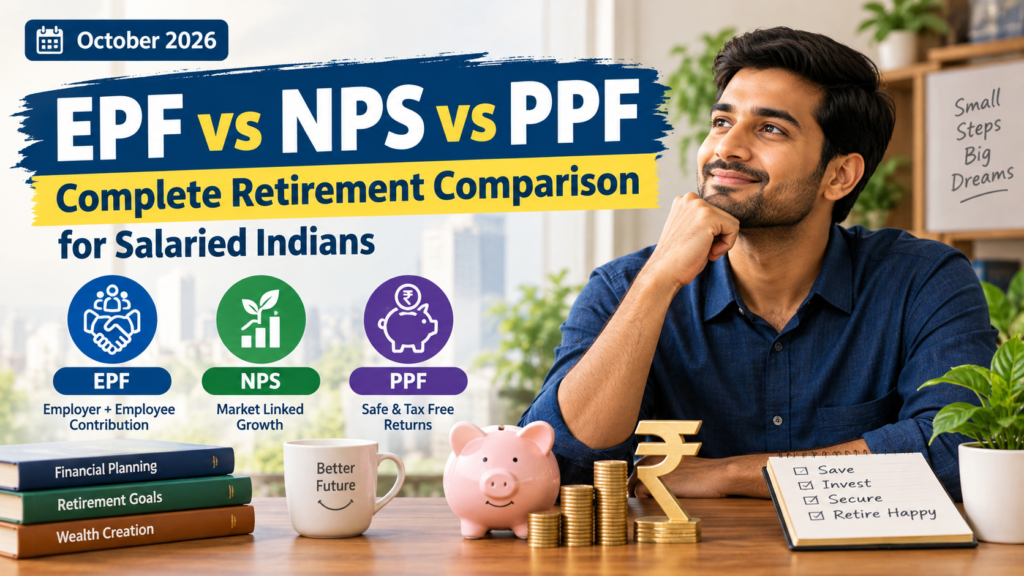
These three instruments are pillars for long-term savings and retirement planning for salaried individuals in India. While they all aim to build a corpus for your future, they work quite differently. They vary in terms of contributions, returns, flexibility, and most importantly, tax treatment. Getting a clear picture of each helps you make informed decisions.Employee Provident Fund (EPF) – The Default Option
EPF is often your first exposure to long-term savings. If you are a salaried employee in an establishment with 20 or more employees, your employer likely deducts 12% of your basic salary plus Dearness Allowance (DA) and contributes it to your EPF account. Your employer also contributes an equal amount. Part of the employer’s contribution (8.33%) goes to the Employees’ Pension Scheme (EPS), capped at ₹1,250 per month. For FY 2023-24, the EPF interest rate was set at 8.25%. This rate is declared annually by the EPFO. Source: EPFO — Verified May 2024EPF Key Features:
- Contributions: Mandatory 12% of basic + DA from employee and employer each (for eligible employees). You can also make Voluntary Provident Fund (VPF) contributions above the 12% limit.
- Returns: Fixed rate, declared annually. Historically, EPF has offered stable, decent returns.
- Taxation: It follows the Exempt-Exempt-Exempt (EEE) model. Contributions (up to ₹1.5 lakh under Section 80C for employee’s share), interest earned, and withdrawals (after 5 years of service) are all tax-exempt. Source: Income Tax Department — Verified May 2024
- Withdrawal: Highly restricted. Full withdrawal usually happens at retirement (age 58). Partial withdrawals are allowed for specific purposes like house purchase, medical treatment, or child’s marriage/education, but with conditions.
National Pension System (NPS) – For Long-Term Growth
The National Pension System (NPS) is a voluntary, long-term retirement-focused investment product. It’s designed to help you build a retirement corpus through market-linked returns. You can choose to invest in a mix of equity, corporate debt, government securities, and alternative assets. NPS has two types of accounts: Tier I and Tier II. Tier I is mandatory for retirement savings and has withdrawal restrictions. Tier II is a voluntary savings account offering more flexibility, but no tax benefits on contributions.NPS Key Features:
- Contributions: Voluntary. You decide how much and how often to contribute. Minimum contribution is ₹500 per transaction and ₹1,000 annually.
- Investment Choice: You get to choose your Pension Fund Manager (PFM) and asset allocation (Equity, Corporate Debt, Government Securities). You can pick an “Active Choice” (you decide the exact percentages) or an “Auto Choice” (asset allocation changes based on your age).
- Returns: Market-linked. This means returns can be higher than fixed-income options like EPF or PPF, but also carry market risk.
- Taxation: It follows an Exempt-Exempt-Taxable (EET) model.
- Contribution: Up to ₹1.5 lakh under Section 80C. An additional deduction of up to ₹50,000 under Section 80CCD(1B) is available, over and above 80C. Employer contributions (up to 10% of basic + DA) are also deductible under Section 80CCD(2). Source: Income Tax Department — Verified May 2024
- Growth: The investment growth is exempt from tax.
- Withdrawal: At maturity (age 60), you must annuitise at least 40% of your corpus (buy an annuity plan that provides regular income). The remaining 60% can be withdrawn as a lump sum, which is tax-exempt.
- Withdrawal: Very restricted before age 60. Partial withdrawals are allowed for specific reasons after 3 years, up to 25% of your own contributions, but only three times in the entire tenure.
Public Provident Fund (PPF) – The Safe Bet
The Public Provident Fund (PPF) is a popular long-term savings scheme backed by the Government of India. It’s known for its safety, guaranteed returns, and excellent tax benefits. Unlike EPF, it’s open to everyone, whether salaried or self-employed.PPF Key Features:
- Contributions: Voluntary. You can deposit a minimum of ₹500 and a maximum of ₹1.5 lakh in a financial year. You can make contributions in a lump sum or up to 12 installments.
- Returns: Fixed rate, declared quarterly by the government. For Q1 FY 2024-25 (April-June 2024), the PPF interest rate is 7.1%. Source: National Savings Institute — Verified May 2024
- Taxation: PPF also follows the EEE (Exempt-Exempt-Exempt) model. Contributions (up to ₹1.5 lakh) are tax-deductible under Section 80C. The interest earned and the maturity amount are completely tax-free.
- Lock-in Period: 15 years. You can extend it in blocks of 5 years after maturity.
- Liquidity: Partial withdrawals are allowed after 7 years from the end of the year the account was opened. Loans against PPF are available from the 3rd to 6th financial year.
EPF vs NPS vs PPF: Key Differences at a Glance
Let’s put them side-by-side to highlight their distinct characteristics. This helps you weigh the pros and cons for your specific retirement goals.| Feature | EPF | NPS | PPF |
|---|---|---|---|
| Target Audience | Salaried Employees | All Citizens (Salaried/Self-employed) | All Citizens (Salaried/Self-employed) |
| Mandatory? | Yes (for eligible employees) | Voluntary | Voluntary |
| Contribution Limit (FY 24-25) | 12% of Basic + DA (employee & employer) + VPF. Interest on employee contrib. >₹2.5L is taxable. | No upper limit on contribution. Tax benefits up to ₹1.5L (80C), ₹50K (80CCD(1B)), 10% of Basic+DA (80CCD(2)). | ₹500 to ₹1.5 lakh per financial year. |
| Investment Choice | None (managed by EPFO) | Asset allocation choice (Equity, Debt, etc.) via PFM. | None (managed by Govt.) |
| Return Potential | Fixed, moderate. Historically 8-9%. | Market-linked, higher potential (can vary). | Fixed, moderate. Historically 7-8%. |
| Tax Benefit on Contributions | Yes, under 80C (employee share up to ₹1.5L) | Yes, 80C (up to ₹1.5L), 80CCD(1B) (extra ₹50K), 80CCD(2) (employer contrib.) | Yes, under 80C (up to ₹1.5L) |
| Tax Benefit on Interest/Growth | Exempt (if service >5 yrs) | Exempt | Exempt |
| Tax Benefit on Withdrawal | Exempt (if service >5 yrs) | 60% lump sum exempt, 40% annuitised (taxable as per income slab) | Exempt (EEE) |
| Lock-in Period | Till retirement (age 58) | Till retirement (age 60) | 15 years (extendable) |
| Liquidity/Early Withdrawal | Very restricted (specific conditions after 5 years service) | Very restricted (specific conditions after 3 years) | Allowed after 7 years (partial), loans after 3 years. |
| Risk Level | Very Low (Govt. backed, fixed interest) | Moderate to High (Market-linked, depends on asset allocation) | Very Low (Govt. backed, fixed interest) |
Meera, a 38-year-old marketing manager in Bangalore, came to me two years ago. Her entire retirement plan was just her EPF. She had a good salary, ₹1.1 lakh monthly, but felt overwhelmed by other options. Her EPF corpus was growing steadily, but she wanted more. We discussed her risk appetite. She was comfortable taking some risk for potentially higher returns.
I explained how adding NPS could give her exposure to equities and help her build a larger corpus. With the additional ₹50,000 tax benefit under 80CCD(1B), she decided to put ₹8,000 into NPS every month, opting for a moderate equity allocation. She also continued her PPF for the safety net. Now, her retirement portfolio is diversified across a safe, fixed-income EPF, a government-backed PPF, and a market-linked NPS. She told me last month, “I feel so much more confident about my future. It’s not just one basket anymore.”
Which One Should YOU Choose? — A Simple Decision Guide
Selecting the right retirement vehicle depends on your current situation, risk appetite, and financial goals.Choose EPF (and VPF) if:
Choose NPS if:
Choose PPF if:
Consider a Mix of All Three if:
Your Next Step — Do This Today
Don’t just read about retirement planning; start acting on it. Here are some concrete steps you can take today.Log in to the EPFO UAN portal to check your current EPF balance and verify your contribution history. This helps you understand your baseline retirement savings.
Go to: EPFO Member Portal
If you’re looking for additional tax benefits (up to ₹50,000 under 80CCD(1B)) and market-linked growth, research NPS. Understand the asset allocation options and fund managers.
Visit: PFRDA NPS Scheme Information
For a safe, tax-free, and government-guaranteed component in your retirement portfolio, consider opening a PPF account at a bank or post office, or increasing your existing contributions (up to ₹1.5 lakh annually).
Check current rates: National Savings Institute
Frequently Asked Questions (FAQs)
Navigating EPF, NPS, and PPF can feel complex, but it doesn’t have to be. Think of them as different tools in your retirement toolkit. Your EPF is your foundation. PPF offers a strong, safe anchor. And NPS gives you that crucial growth potential.
The key is to understand what each offers and how they fit into your overall financial plan. Don’t wait until retirement is knocking at your door. Start planning strategically today. Your future financially free self will thank you for making these smart choices.