“Every year during ITR season, I see the same pattern — salaried employees either skip their HRA exemption entirely, or calculate it using the wrong salary figure. I have reviewed hundreds of salary slips over my career. HRA exemption is one of the largest tax benefits available to any salaried person in India, and it requires zero extra investment. You are already paying rent. The only question is whether you are claiming it correctly.”
— Anshuman Kumar, FP&A Manager & Finance Expert, InfoBuddy
Who this guide is for: Any salaried employee in India who receives HRA as part of their salary, pays rent, and wants to claim the maximum possible tax exemption — correctly — when filing their ITR for FY 2025-26 (AY 2026-27).
Your salary slip shows an HRA component. Your company deducts TDS every month. But are you actually claiming the full HRA exemption you are entitled to?
Most salaried employees are not. Either they skip the declaration entirely, or they submit the wrong numbers. The result is thousands of rupees in extra tax paid — completely unnecessarily.
This guide breaks down the HRA exemption rule with real numbers, step-by-step calculations, and the most common mistakes people make — so you can walk into ITR filing season fully prepared.
What is HRA and Why Does It Matter for Taxes?
House Rent Allowance (HRA) is a component of your salary that your employer pays to help cover your rental housing costs. It is part of your Cost to Company (CTC) and shows up as a line item on your monthly payslip.
Under Section 10(13A) of the Income Tax Act, a portion of your HRA is exempt from income tax — meaning it is not added to your taxable income. This can save you anywhere from ₹20,000 to ₹1,50,000+ in taxes every year depending on your salary and city.
⚠️
Important: HRA exemption is only available under the old tax regime. If you have opted for the new tax regime, you cannot claim HRA exemption. Before claiming HRA, confirm which tax regime you are filing under with your employer or CA.
The HRA Exemption Formula — Three Numbers, Pick the Lowest
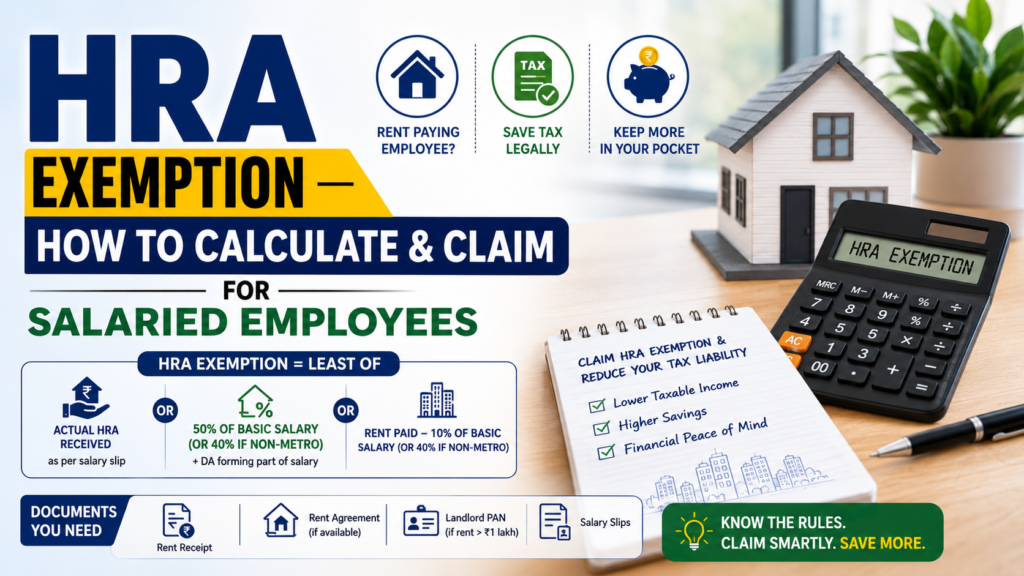
The HRA exemption is not a flat percentage of your salary. It is calculated using three different numbers, and you can only claim the lowest of the three. This is where most people go wrong.
Metro vs Non-Metro — What Rate Applies to You?
Metro Cities — 50% Rule
50%
For FY 2025-26 (filing by July 2026):
Delhi · Mumbai · Kolkata · Chennai
From FY 2026-27 onwards (new rule):
+ Bengaluru · Hyderabad · Pune · Ahmedabad
Non-Metro Cities — 40% Rule
40%
All other cities in India — Noida, Gurugram, Lucknow, Jaipur, Surat, Indore, Chandigarh, Kochi, Nagpur, and all Tier 2 and Tier 3 cities.
🆕
New Rule from FY 2026-27: Under the Income Tax Rules 2026 (effective April 1, 2026), Bengaluru, Hyderabad, Pune, and Ahmedabad have been added to the metro cities list — upgrading their HRA exemption ceiling from 40% to 50% of basic salary. This does NOT apply to FY 2025-26 ITR filing. Use the 40% rule for these cities for the current year’s filing.
Step-by-Step HRA Calculation — Metro City Example
👤
Priya — Software Engineer, Mumbai
Metro city · Old tax regime · FY 2025-26
Monthly Basic Salary₹50,000
Monthly HRA received from employer₹20,000
Actual rent paid per month₹25,000
CityMumbai (Metro — 50% rule)
Calculation 1 — Actual HRA received₹20,000/month = ₹2,40,000/year
Calculation 2 — 50% of Basic (metro)50% × ₹50,000 × 12 = ₹3,00,000/year
Calculation 3 — Rent paid minus 10% of Basic(₹25,000 − ₹5,000) × 12 = ₹2,40,000/year
✅ HRA Exemption = Lowest of the three₹2,40,000/year
Priya can deduct ₹2,40,000 from her taxable income. At a 20% tax slab, this saves her ₹48,000 in tax — money she keeps simply by correctly submitting her rent details.
Step-by-Step HRA Calculation — Non-Metro City Example
👤
Rahul — Sales Manager, Pune
Non-metro city (FY 2025-26) · Old tax regime
Monthly Basic Salary₹40,000
Monthly HRA received₹15,000
Actual rent paid per month₹18,000
CityPune (Non-metro for FY 2025-26 — 40% rule)
Calculation 1 — Actual HRA received₹15,000 × 12 = ₹1,80,000/year
Calculation 2 — 40% of Basic (non-metro)40% × ₹40,000 × 12 = ₹1,92,000/year
Calculation 3 — Rent paid minus 10% of Basic(₹18,000 − ₹4,000) × 12 = ₹1,68,000/year
✅ HRA Exemption = Lowest of the three₹1,68,000/year
Rahul saves ₹1,68,000 from taxable income. At 20% slab, that is ₹33,600 in tax savings this year alone.
📖 Real Example — What a Wrong Calculation Costs
Vikram, a 28-year-old working in Bengaluru, submitted his HRA declaration using his gross salary (₹75,000/month) instead of his basic salary (₹35,000/month). His employer calculated HRA based on the wrong base, resulting in a lower-than-correct exemption. When he filed his ITR himself and used the correct basic salary figure, his HRA exemption jumped by ₹84,000 — which meant an additional tax refund of ₹16,800 at his slab rate.
He had been overpaying tax for three years before a colleague pointed this out. The fix took 15 minutes. The recovery took three revised returns.
Documents You Need to Claim HRA Exemption
1
Rent Receipts — Mandatory
You must have rent receipts for the period you are claiming exemption. The receipt should include: date, amount paid, landlord’s name, landlord’s signature, and your address. Most employers accept monthly or quarterly receipts.
💡
If your monthly rent is above ₹8,333 per month (₹1 lakh per year), you must provide your landlord’s PAN card number. Without this, your employer cannot give you the full HRA exemption in TDS calculation.
2
2
Rent Agreement (Recommended)
A registered or notarised rent agreement is strong supporting proof. While not always mandatory for employer submission, it is important if your ITR is selected for scrutiny. Keep the agreement safe for at least 7 years from the date of filing.
Always pay rent by bank transfer — NEFT, UPI, or cheque. Cash payments above ₹2,000 are not recommended as they leave no traceable proof. A bank statement showing consistent monthly rent payments is your strongest supporting document if questioned.
4
Landlord’s PAN (If Rent Exceeds ₹1 Lakh/Year)
If your annual rent exceeds ₹1,00,000 (i.e., more than ₹8,333/month), you must collect your landlord’s PAN and submit it to your employer. If the landlord does not have a PAN, they must give you a declaration to that effect. Without this, your employer will not be able to grant the full HRA exemption in your Form 16.
⚠️
If you fail to provide your landlord’s PAN for rent above ₹1 lakh/year, your employer will deduct TDS on the full HRA amount. You can still claim the exemption in your ITR — but you will need to wait for the refund.
Can You Pay Rent to Your Parents and Claim HRA?
Yes — and this is one of the most effective and completely legal tax-saving strategies available to salaried Indians. Here is how it works:
- You pay rent to your parents every month — by bank transfer
- Your parents declare this rental income in their own ITR
- You claim HRA exemption using rent receipts signed by your parents
- Your parents can deduct 30% of rental income as standard deduction and pay tax only on the rest
✅
Example: You pay ₹15,000/month rent to your parents. You claim ₹1,80,000/year as HRA exemption. Your parents declare ₹1,80,000 as rental income, deduct 30% (₹54,000) as standard deduction, and pay tax only on ₹1,26,000 — which at their lower slab may be zero. You save significantly; they pay little or nothing. Both sides benefit legally.
⚠️
You cannot pay rent to your spouse to claim HRA. The Income Tax Act does not permit this. Rent paid to parents is allowed; rent paid to a husband or wife is not.
What If You Change Jobs Mid-Year?
If you changed employers during FY 2025-26, calculate your HRA exemption separately for each employment period and add them together. Each employer will issue a separate Form 16 — combine both when filing your ITR.
| Scenario | How to Handle |
|---|
| Changed jobs in same city | Calculate HRA separately for each employer’s period. Add both exemptions in ITR. |
| Changed cities mid-year | Apply 50% or 40% rule based on which city you were in for each period. |
| Moved to own house mid-year | Claim HRA only for the months you were on rent. Zero exemption for months in own house. |
| Rent changed during the year | Calculate each period separately with the actual rent for that period. |
6 Most Common HRA Mistakes — And How to Avoid Them
❌ Wrong
Using gross salary or CTC as the base for HRA calculation
✅ Right
Use only Basic Salary + DA (retirement portion) as the salary base — nothing else
❌ Wrong
Not submitting rent proof to employer and missing TDS adjustment
✅ Right
Submit rent receipts + landlord PAN (if applicable) to HR before the employer’s TDS declaration deadline — usually January-February
❌ Wrong
Paying rent in cash above ₹2,000 — no traceable proof if scrutinised
✅ Right
Always pay rent via bank transfer, UPI, or cheque — bank statement is your strongest proof
❌ Wrong
Skipping HRA claim just because you own a house in your hometown
✅ Right
You can claim HRA even if you own a house elsewhere — as long as you are actually living in rented accommodation where you work
HRA Exemption — Quick Reference Table
| Situation | Can You Claim HRA? |
|---|
| Living in rented house, old tax regime | Yes — full calculation applies |
| Living in own house | No — HRA fully taxable |
| New tax regime | No — HRA exemption not available |
| Paying rent to parents | Yes — legal and tax-efficient |
| Paying rent to spouse | No — not permitted |
| Self-employed (no HRA in salary) | No HRA — claim Section 80GG instead |
| Own house in another city, renting where you work | Yes — you can claim HRA and home loan benefit both |
| Rent above ₹1 lakh/year, no landlord PAN | Claim in ITR directly — employer cannot process without PAN |
Frequently Asked Questions
What is the maximum HRA exemption I can claim?
There is no fixed maximum limit under Section 10(13A). The exemption is the lowest of the three calculations — actual HRA received, 50%/40% of basic salary, or rent minus 10% of basic salary. The higher your rent and basic salary, the higher your potential exemption. For high-salary metro city employees, this can exceed ₹3-4 lakhs per year.
Can I claim HRA if my employer does not give me HRA?
If your salary structure does not include an HRA component, you cannot claim HRA exemption under Section 10(13A). However, you can claim a deduction under Section 80GG — which allows self-employed people and salaried employees without HRA to deduct rent paid, up to a maximum of ₹60,000 per year, subject to conditions.
My employer did not apply the HRA exemption. Can I still claim it in my ITR?
Yes. Even if your employer deducted full TDS without accounting for HRA, you can claim the exemption directly in your ITR under Schedule EI (Exempt Income) when you file. The excess TDS will be refunded to your bank account. Make sure you have all rent receipts and documents ready for this.
Do I need to submit HRA proof to my employer every year?
Yes. Your employer typically asks for rent declaration and proof once a year — usually between November and February. Submit your rent receipts, landlord’s PAN (if rent exceeds ₹1 lakh/year), and rent agreement to HR before the deadline. Missing this deadline means your employer cannot reduce your TDS — but you can still claim the exemption in your ITR.
Can I claim HRA exemption and home loan deduction simultaneously?
Yes — in specific situations. If you have taken a home loan for a property in a different city and are living on rent in the city where you work, you can claim both HRA exemption and home loan interest deduction under Section 24(b). However, if you own a house in the same city where you work but still choose to rent elsewhere, the claim may be questioned. Keep proper justification ready.
Is HRA available in the new tax regime from FY 2026-27?
No. HRA exemption under Section 10(13A) is only available under the old tax regime, even after the new Income Tax Act 2025 came into effect from April 1, 2026. If you opt for the new tax regime — which has lower tax rates but fewer deductions — you cannot claim HRA, Section 80C investments, or most other exemptions.
HRA exemption is the easiest tax saving available to any salaried employee in India. It requires no investment, no new financial product, and no complicated planning. You are already paying rent. The only thing left is to calculate it correctly and submit the right documents on time.
Three things to do before July 31, 2026:
1. Confirm you are on the old tax regime. 2. Calculate your HRA exemption using your basic salary — not CTC. 3. Collect rent receipts and your landlord’s PAN if rent exceeds ₹1 lakh per year.
That is it. No CA required for this part. Just the right numbers and the right documents.
📤 Know a colleague who might be overpaying tax? Share this.
WhatsApp
AK
Anshuman Kumar
FP&A Manager | MBA Finance, Bharti Vidyapeeth | 10+ Years in Financial Planning & Taxation
Anshuman is a Financial Planning & Analysis professional with over 10 years of hands-on experience in Indian taxation, payroll compliance, TDS management, and financial planning. He has reviewed and processed hundreds of HRA declarations and ITR filings in his professional career. He writes and reviews all tax and finance content on InfoBuddy to ensure accuracy and real-world relevance for Indian salaried employees.
Disclaimer: This article is based on the Income Tax Act, 1961 (and relevant provisions of the Income Tax Act, 2025 effective April 1, 2026) and is for educational purposes only. Tax laws are subject to change, and individual circumstances vary. The examples used are illustrative. Please consult a qualified Chartered Accountant or tax advisor for personalised tax advice before filing your ITR. InfoBuddy is not a SEBI-registered advisor or a licensed tax consultant.