
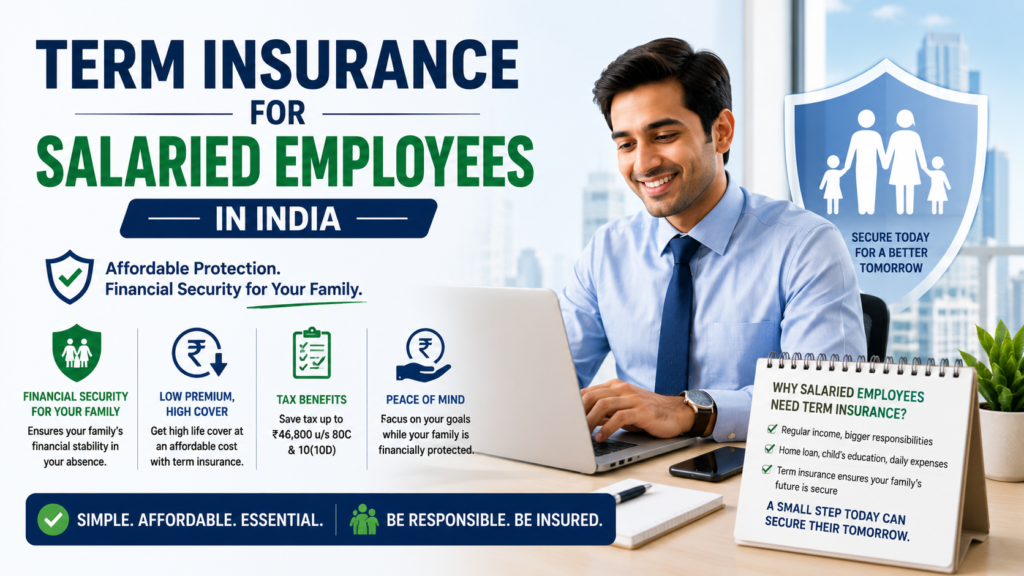
Your income protects your family today. Term insurance protects them tomorrow.
Here is everything you need to know before buying.
📋 Table of Contents
Your Salary Stops. Their Life Does Not.
Think about this for a moment.
Every month, your salary hits your account. EMI deductions happen automatically. Rent gets paid. School fees clear. Groceries, medicines, family outings — everything runs because you show up to work every single day.
Now imagine that income suddenly stops — permanently.
What happens to your family’s home loan EMI? Who pays the school fees next month? How does your spouse manage household expenses without your salary?
This is not a scare tactic. This is the reality that millions of Indian families face every year — without any financial protection in place. Term insurance for salaried employees in India is the most powerful and most affordable tool to ensure your family never has to answer these questions alone.
What is Term Insurance — Explained Simply
Term insurance is a pure life insurance policy. You pay a small premium every month or year. In return, if something happens to you during the policy period, your family receives a large lump sum amount — called the death benefit.
That is it. No investment component. No maturity bonus. No returns if you survive.
Pure protection — at the lowest possible cost.
Rahul is 30 years old — non-smoker, salaried professional earning ₹8 lakh per year.
He buys a ₹1 crore term insurance plan for 30 years.
His monthly premium — approximately ₹550 per month.
That is less than a dinner for two at a mid-range restaurant — for a ₹1 crore guarantee to his family.
Why Salaried Employees Need Term Insurance More Than Anyone Else
Most salaried professionals think — “My company gives me life insurance. I am already covered.”
Here is the truth your HR will never tell you:
Financial experts and IRDAI guidelines recommend a minimum coverage of 10 to 15 times your annual income. For a ₹6 lakh salary, that means at least ₹60–₹90 lakh — ideally ₹1 crore or more.
There is another critical problem — group insurance ends the day you leave the company. Resignation, layoff, or retirement — your coverage disappears overnight. And buying a fresh individual policy at 45 or 50 years costs significantly more than buying one today.
How Much Term Insurance Do You Actually Need?
Use this simple formula recommended by certified financial planners:
| Your Situation | Calculation | Recommended Cover |
|---|---|---|
| Salary ₹5L/year, no loans | ₹5L × 15 | ₹75 lakh |
| Salary ₹8L/year, home loan ₹30L | (₹8L × 15) + ₹30L | ₹1.5 crore |
| Salary ₹12L/year, home loan ₹50L | (₹12L × 15) + ₹50L | ₹2.3 crore |
| Salary ₹20L/year, home + car loan ₹70L | (₹20L × 15) + ₹70L | ₹3.7 crore |
Always round up to the nearest ₹50 lakh or ₹1 crore. The premium difference is minimal — the protection difference is massive.
Best Term Insurance Plans for Salaried Indians in 2026
Based on Claim Settlement Ratio (CSR) data from the IRDAI Annual Report 2024–25, here are the top plans worth comparing:
| Plan Name | CSR (2024–25) | Approx. Premium (₹1 Cr, Age 30) | Best For |
|---|---|---|---|
| Axis Max Life Smart Term Plus | 99.62% | ~₹550/month | Best overall |
| HDFC Life Click2Protect Supreme | 99.55% | ~₹620/month | Best service quality |
| ICICI Pru iProtect Smart Plus | 98.55% | ~₹580/month | Salaried with riders |
| Tata AIA Sampoorna Raksha | 98.53% | ~₹510/month | Budget-friendly |
| Bajaj Life eTouch II | 98.03% | ~₹480/month | Lowest premium |
What Does Term Insurance Cover — and What It Does Not
- Death due to natural causes — illness, organ failure, age-related conditions
- Death due to accident — road accidents, workplace accidents, falls
- Death due to critical illness (with rider) — heart attack, cancer, stroke
- Terminal illness payout — many plans pay early on diagnosis, not just on death
- Death by suicide — not covered within the first year of policy (most policies)
- Undisclosed pre-existing conditions — claim can be rejected if you hid a health condition while applying
- Maturity benefit — if you survive the policy term, you receive nothing back (unless Return of Premium option is chosen)
Term Insurance Riders — What Should Salaried Employees Add?
Riders are optional add-ons to your base term plan. They cost a small extra premium but dramatically increase your protection coverage.
Covers 32–64 critical illnesses including cancer, heart attack, and stroke. You receive a lump sum on diagnosis — not just on death.
If death is due to an accident, your family receives an additional payout on top of the base cover — up to 2x the base amount.
If you become permanently disabled or diagnosed with a critical illness, all future premiums are waived. Policy continues at zero cost.
Your family receives a fixed monthly income for 10–20 years instead of a lump sum. Ideal if your spouse prefers regular payouts.
The Right Age to Buy Term Insurance — And Why Waiting Is Costly
This is where most salaried professionals make a costly mistake — they wait until their 30s or 40s to buy term insurance. By then, premiums are significantly higher.
| Age at Purchase | Approx. Monthly Premium (₹1 Cr, 30-yr term) | Extra Annual Cost vs Age 25 |
|---|---|---|
| 25 years | ~₹450/month | Base rate |
| 30 years | ~₹550/month | ₹1,200/year more |
| 35 years | ~₹800/month | ₹4,200/year more |
| 40 years | ~₹1,400/month | ₹11,400/year more |
| 45 years | ~₹2,500/month | ₹24,600/year more |
The best time to buy term insurance was when you started earning. The second best time is today. Waiting from age 25 to 40 costs you approximately ₹3.5–₹4 lakh extra over the entire policy term — for the exact same coverage.
Tax Benefits of Term Insurance in India
Term insurance is not just protection — it is also a tax-saving tool for salaried employees under the old tax regime.
| Tax Section | Benefit | Limit |
|---|---|---|
| Section 80C | Premium paid is tax-deductible | Up to ₹1.5 lakh/year |
| Section 10(10D) | Death benefit is completely tax-free | No upper limit |
You are in the 30% tax bracket and pay ₹15,000/year in term insurance premium.
Tax deduction benefit = ₹15,000 × 30% = ₹4,500 saved per year
Effective annual cost of your ₹1 crore coverage = ₹10,500/year (₹875/month)
How to Buy Term Insurance Online — Step by Step
Buying term insurance in 2026 is entirely online. No agent visit required. The entire process takes 30–45 minutes.
-
1Calculate your coverage need
Use the formula: (Annual Income × 15) + Outstanding Loans. Use our Free EMI Calculator to estimate your financial liabilities first.
-
2Compare plans online
Visit PolicyBazaar, Ditto Insurance, or individual insurer websites. Compare Claim Settlement Ratio, premiums, and available riders side by side.
-
3Fill the application form accurately
Provide accurate personal details — age, income, health history, smoking status. Never misrepresent any information. It can lead to claim rejection.
-
4Complete medical tests
Most insurers require a basic health checkup for cover above ₹50 lakh. Medically fit applicants often receive lower premium rates.
-
5Pay premium and receive policy
Policy document arrives digitally within 7–15 working days. Download it and save it in multiple locations — email, cloud storage, and a physical copy.
-
6Inform your nominee — most important step
Your family must know: which company, what policy number, how to file a claim. Share the insurer’s claim helpline number with your spouse right now.
5 Mistakes Salaried Employees Make With Term Insurance
-
❌ Mistake 1 — Relying only on employer group insurance
Group cover is 2–3x salary at best — far below the recommended 10–15x. And it ends the day you change jobs or retire.
-
❌ Mistake 2 — Buying too little cover to save on premium
The difference between ₹50 lakh and ₹1 crore cover is roughly ₹150–₹200/month. The difference in protection is enormous.
-
❌ Mistake 3 — Not disclosing pre-existing health conditions
If you hide a health condition and it causes death, the insurer can legally reject the claim. Always disclose everything. Honesty here directly protects your family.
-
❌ Mistake 4 — Buying endowment or ULIP instead of pure term
Insurance agents push investment-linked plans for higher commissions. For pure income replacement and protection — always choose a plain term plan first.
-
❌ Mistake 5 — Never reviewing coverage after major life events
Got married? Had a child? Took a home loan? Your protection need just increased. Review your term insurance after every major financial milestone in life.
Term Insurance vs Life Insurance vs ULIP — Quick Comparison
| Feature | Term Insurance | Endowment / LIC | ULIP |
|---|---|---|---|
| Purpose | Pure protection | Protection + savings | Protection + investment |
| Monthly Premium | Very low | Very high | High |
| Coverage Amount | Very high | Low | Medium |
| Returns on Survival | None (or ROP option) | Guaranteed returns | Market-linked returns |
| Best For | Income replacement | Forced savings | Long-term wealth |
| Recommendation | ✅ Always buy | ⚠️ Only if needed | ❌ Usually avoid |
Frequently Asked Questions
Can I have two term insurance policies from different companies?
What happens to my term insurance if I change jobs?
What is the minimum salary required to buy term insurance?
Is ₹1 crore enough coverage in 2026?
Can a homemaker or self-employed person buy term insurance?
What is the difference between term insurance and life insurance?
Your Income Protects Your Family Today.
Term Insurance Protects Them Tomorrow.
The premium you pay — ₹500 to ₹1,000 per month — is smaller than most monthly subscriptions. Buy early. Buy adequate. Disclose honestly. Inform your nominee. These four steps are all it takes.
Calculate Your EMI First →