
This comprehensive guide is specifically designed for salaried individuals in India. If you earn a salary and are wondering whether to file ITR-1 or ITR-2, you’re in the right place. We simplify the complexities to help you make the correct choice.
Every year, as the tax filing season approaches, many salaried individuals face a common dilemma: which Income Tax Return (ITR) form should I use? The choice between ITR-1 and ITR-2 is a frequent point of confusion. Selecting the wrong form can create unnecessary complications. Therefore, understanding the key distinctions is essential.
This guide will help you clearly differentiate between ITR 1 vs ITR 2. We will break down their eligibility criteria. Moreover, you will learn to identify the form that perfectly matches your income profile. Let’s ensure your tax filing journey is smooth and compliant this year.
Decoding ITR-1 vs ITR-2: The Basics for Salaried Individuals
The Income Tax Department of India has different forms for various types of taxpayers and income sources. ITR-1 and ITR-2 are two of the most common forms. They cater to specific categories of individual taxpayers. Knowing the appropriate form is the cornerstone of accurate tax filing.
What is ITR-1 (Sahaj)?
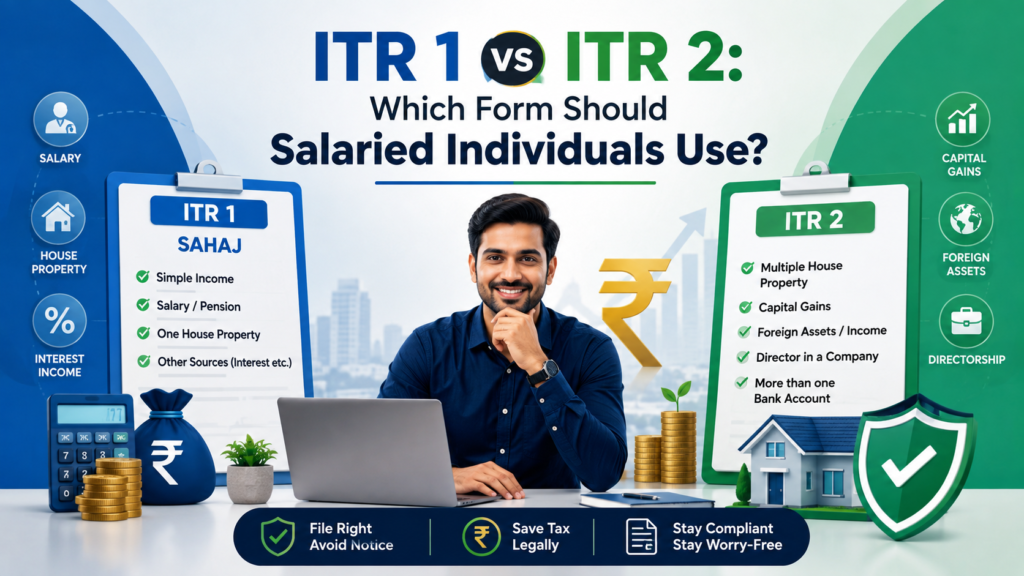
ITR-1, also known as ‘Sahaj’, is designed for ordinary residents whose total income does not exceed ₹50 Lakh. It covers income from salary, one house property, other sources like interest, and agricultural income up to ₹5,000. It is a simplified form, as its name suggests.
What is ITR-2?
ITR-2 is for individuals and Hindu Undivided Families (HUFs) who do not have income from profits and gains of business or profession. This form caters to a wider range of income sources. These include capital gains, income from more than one house property, and foreign income. It also applies if you are a director in a company or hold unlisted equity shares.
The primary difference lies in the complexity and diversity of income sources. ITR-1 is for simpler financial profiles. Conversely, ITR-2 is for those with more varied or complex income streams. Let’s dive deeper into each form’s specific eligibility rules.
When Should You Use ITR-1 (Sahaj)?
ITR-1 (Sahaj) is the most common form chosen by salaried individuals. However, its use comes with specific conditions. You must meet all these criteria to be eligible for ITR-1. This form is ideal if your financial situation is relatively straightforward.
You must be a ‘Resident’ (not ‘Not Ordinarily Resident’ or ‘Non-Resident’). Therefore, if you have lived abroad for a significant period or your residential status is complex, you might need another form.
Your total income for the financial year must not exceed ₹50 Lakh. This includes all your taxable income from various allowed sources. Always ensure you calculate your total income accurately.
You can only have income from the following sources:
- Salary/Pension: Your primary employment income or pension.
- One House Property: Income from a single house property, which can be self-occupied or rented out. However, if you have more than one house property, ITR-1 is not applicable.
- Other Sources: This generally includes interest income from savings accounts, fixed deposits, or family pension. Income from horse racing, lottery, or gambling is not permitted in ITR-1.
- Agricultural Income: Up to ₹5,000 only. Beyond this, you cannot use ITR-1.
You cannot use ITR-1 if you have any of the following:
- Income from Capital Gains (e.g., selling shares, property, mutual funds).
- Income from Business or Profession.
- Income from more than one house property.
- Foreign assets or foreign income.
- Are a director in a company.
- Hold unlisted equity shares at any time during the financial year.
- Income under Section 115BBDA (dividend income exceeding ₹10 Lakh prior to AY 2021-22, now taxed as other sources) or Section 115BBC (undisclosed income).
Therefore, carefully review all your income sources before deciding on ITR-1. Even a single disqualifying factor means you must opt for ITR-2 or another relevant form. Using an Income Tax Calculator can help estimate your total income for the year.
Understanding ITR-2: Who Needs It?
If you don’t qualify for ITR-1, chances are you need to file ITR-2. This form is for individuals and HUFs with more complex income structures. It covers a broader spectrum of income and assets. Importantly, ITR-2 is a common choice for salaried individuals who have ventured into investments or own multiple properties.
| ITR-2 Eligibility Criterion | Explanation for Salaried Individuals |
|---|---|
| Capital Gains Income | If you sold shares, mutual funds, property, or any other capital asset, you must file ITR-2. This includes both long-term and short-term capital gains. |
| More than One House Property | Even if only one property is rented out and others are self-occupied, or if you own multiple rented properties, ITR-2 is required. |
| Foreign Income or Assets | Do you have income from sources outside India? Do you hold any foreign assets? Then ITR-2 is your form. This also includes signing authority in any account located outside India. |
| Director in a Company | If you are a director in any company (listed or unlisted), regardless of your income level, you need to file ITR-2. |
| Unlisted Equity Shares | Holding unlisted equity shares at any point during the financial year mandates filing ITR-2. This is a common trap for many salaried individuals. |
| Not Ordinarily Resident (NOR) or Non-Resident (NRI) | If your residential status is NOR or NRI, you cannot file ITR-1. ITR-2 is the appropriate choice. |
Clearly, ITR-2 caters to situations where your income profile moves beyond just salary and basic interest. If any of the above conditions apply to you, you must select ITR-2. Trying to force a complex income scenario into an ITR-1 form can lead to rejection or penalty from the Income Tax Department.
A Real-Life Scenario: Choosing the Right ITR Form
Let’s consider a practical example to illustrate the choice between ITR 1 vs ITR 2. This will help you relate these rules to your own financial journey. Meet our reader, Rohan, who faced this exact dilemma.
Rohan, a 32-year-old software engineer from Bengaluru, earns an annual salary of ₹18 Lakh. He also has interest income of ₹30,000 from his savings account and ₹50,000 from a Fixed Deposit. In the past, he always filed ITR-1 without a second thought.
However, in the last financial year, Rohan sold some equity mutual fund units he had held for over two years. This sale resulted in a long-term capital gain of ₹1.5 Lakh. Additionally, he inherited a small ancestral shop in his hometown, Mysuru, which he rented out for ₹10,000 per month. This meant he now had income from two house properties (his self-occupied apartment in Bengaluru and the rented shop in Mysuru).
Initially, Rohan thought he could still use ITR-1 as his total income was well below ₹50 Lakh. But after a quick check on InfoBuddy.in, he realized his situation had changed. The capital gains income and income from two house properties automatically disqualified him from ITR-1. Therefore, he had to file ITR-2. This choice ensured he was compliant and avoided any potential issues with the Income Tax Department.
Rohan’s story highlights how quickly your ITR form requirement can change. New investments or property acquisitions directly impact your filing obligation. Always reassess your situation each year.
Do’s and Don’ts When Selecting Your ITR Form
Making the right choice between ITR 1 vs ITR 2 can seem overwhelming. Follow these simple do’s and don’ts to navigate the process effectively. These guidelines will help you stay compliant and avoid common mistakes.
- Do list all your income sources. Include salary, interest, rent, and capital gains. A complete picture is crucial.
- Do check your residential status. Ensure you are a ‘Resident’ for ITR-1 eligibility.
- Do verify your asset holdings. Confirm if you hold any foreign assets or unlisted equity shares.
- Do consult official resources. Refer to incometax.gov.in for the latest eligibility rules.
- Do maintain proper records. Keep all income proofs, investment statements, and property documents organized.
- Don’t assume your form from last year is suitable. Your financial situation might have changed.
- Don’t ignore capital gains. Even small gains disqualify you from ITR-1.
- Don’t hide multiple house properties. All rental income and property details must be declared.
- Don’t forget director status or unlisted shares. These are clear ITR-2 triggers.
- Don’t delay filing. Late filing can attract penalties and interest.
By adhering to these simple principles, you can confidently choose between ITR 1 vs ITR 2. This proactive approach ensures a stress-free tax season for you.
Frequently Asked Questions about ITR 1 vs ITR 2
Navigating the world of income tax can feel daunting, but choosing the right ITR form doesn’t have to be. Understanding the fundamental differences between ITR 1 vs ITR 2 is your first step towards a compliant and hassle-free tax filing experience.
For most salaried individuals with straightforward finances, ITR-1 (Sahaj) offers simplicity. However, if your financial landscape includes capital gains, multiple house properties, or foreign assets, ITR-2 is your essential tool. Remember, accuracy and compliance are key. Always review your income sources and asset holdings carefully each year. This vigilance ensures you select the correct form and fulfill your tax obligations effectively.