
Who this guide is for:
- Salaried employees who receive Form 16.
- First-time taxpayers or those new to filing ITR in India.
- Anyone looking to understand their tax deductions better.
- Professionals from Tier 2-3 cities seeking simple finance education.
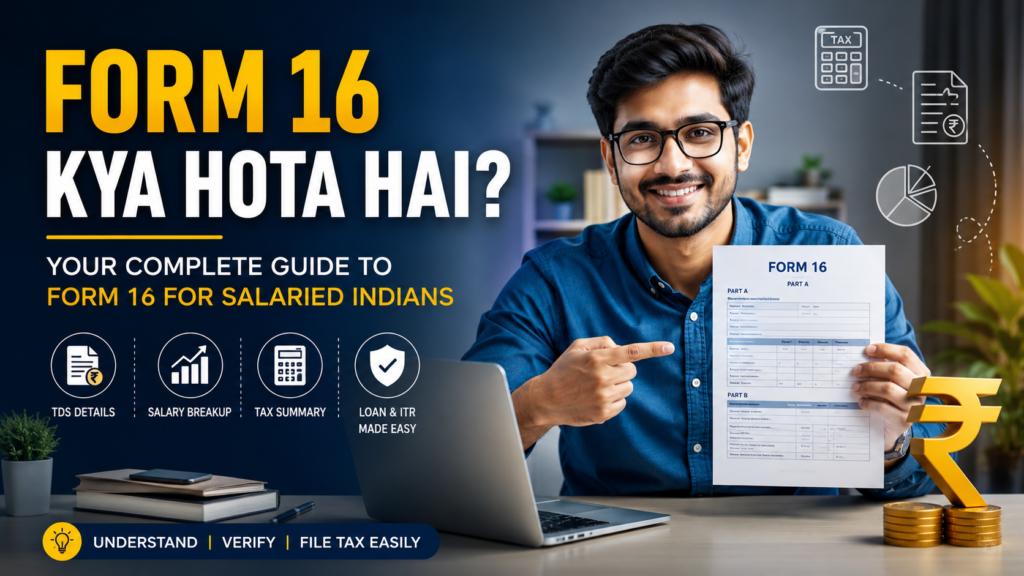
Every year, as a salaried Indian, you look forward to that one crucial document from your employer: Form 16. But what exactly is this document? For many, it’s just a piece of paper handed over at the end of the financial year. However, it’s much more than that; it’s your comprehensive guide to income and taxes deducted at source (TDS).
Understanding Form 16 is key to managing your personal finance and ensuring a smooth tax filing process. This guide is specifically designed to demystify Form 16 Explained for Salaried individuals like you. We will break down its components, highlight its importance, and show you how to use it effectively for your Income Tax Return (ITR).
Without a clear grasp of this form, you might miss out on important tax details or face difficulties during ITR filing. Therefore, let’s dive deep into what Form 16 truly means for your financial health.
What Exactly Is Form 16 and Why Is It Important for Salaried Individuals?
Imagine your employer deducting a part of your salary every month as tax. This is called Tax Deducted at Source (TDS). Form 16 is essentially a certificate issued by your employer, confirming that they have deducted tax from your salary and deposited it with the government.
This document acts as proof of the taxes you’ve already paid. It’s mandatory for employers to issue Form 16 to employees from whom they have deducted TDS. Moreover, this certificate provides a detailed summary of your salary, perquisites, allowances, and any tax-saving investments declared by you.
Why is Form 16 so important? First, it simplifies the process of filing your Income Tax Return. All the necessary information for your salary income is readily available. Second, it serves as an official record of your income and TDS, which can be useful for loan applications or visa processes. Furthermore, it ensures transparency in your tax dealings.
If your employer has not deducted any TDS from your salary because your income falls below the taxable limit, they are not legally obligated to issue Form 16. However, they might still provide a salary statement detailing your income and deductions. It’s always wise to ask for it.
Understanding the Two Crucial Parts of Form 16
Form 16 is not a single document; it actually consists of two main parts: Part A and Part B. Both sections contain vital information for filing your Income Tax Return. Knowing what each part contains will empower you to cross-check details and ensure accuracy.
Part A of Form 16: The TDS Summary
Part A is a summary of the TDS deducted by your employer. It offers a quick overview of your tax payments throughout the financial year. You will find several key details here.
This includes the name and address of your employer, their PAN (Permanent Account Number), and TAN (Tax Deduction and Collection Account Number). Your name and PAN are also listed here, ensuring the certificate belongs to you.
The relevant assessment year (e.g., AY 2024-25 for FY 2023-24) and the period of your employment with that specific employer during the financial year are clearly mentioned. Consequently, it covers all months you worked and earned from that employer.
Most importantly, Part A details the total tax deducted at source from your salary each quarter. It also shows the date of deposit of this tax and the unique TDS acknowledgement number (CIN). You must match these figures with your Form 26AS for accuracy.
Part B of Form 16: The Salary and Deduction Breakdown
Part B offers a detailed break-up of your salary, exempt allowances, deductions, and the net taxable income. This section is usually prepared by your employer manually, though many HR systems automate it now. It gives you a clear picture of how your final tax liability was calculated.
Here, you’ll find your gross salary, including basic pay, allowances (like HRA, DA, Transport Allowance), and any perquisites. This is the total income before any deductions.
Certain allowances are fully or partially exempt from tax under Section 10 of the Income Tax Act. For instance, House Rent Allowance (HRA) can be partially exempt based on rules. You can learn more about HRA exemption here. These exempt amounts are listed here.
This is where your tax-saving investments and expenses come into play. Deductions under sections like 80C (EPF, PPF, ELSS), 80D (health insurance), 80G (donations), etc., are itemized. This reduces your taxable income significantly.
After all deductions and exemptions, your net taxable income is calculated. Based on this, the tax liability for the year is determined, and any TDS already deducted is accounted for. This is the final picture of your tax situation.
How Form 16 Helps You File Your Income Tax Return (ITR) Seamlessly
Filing your ITR might seem daunting, but with Form 16, it becomes a relatively straightforward process. This certificate contains almost all the data you need for your salary income. You can simply transfer the figures from Form 16 to your ITR form.
When you file your ITR, you will input your gross salary, exempt allowances, and deductions exactly as they appear in Part B of your Form 16. The TDS details from Part A will be matched against your Form 26AS, which is an annual tax statement available on the income tax portal. Thus, ensuring these documents reconcile is critical.
Moreover, if you changed jobs during the financial year, you will receive Form 16 from each employer. In such cases, you must consolidate the information from all your Form 16s to file a single ITR. This ensures all your income and TDS are reported correctly.
Using Form 16 diligently not only simplifies your ITR filing but also helps you understand your tax liabilities and deductions better. It makes you a more informed taxpayer. Therefore, treat your Form 16 as an essential financial document.
A Real-Life Story: Priya’s Smooth ITR Filing Thanks to Form 16
Priya, a software engineer in Pune, always found tax filing to be a stressful affair. In her initial years, she would scramble to gather documents and often rely on last-minute help from friends. She sometimes even paid extra charges to tax consultants. She worried about errors and potential notices from the tax department.
Last year, Priya decided to understand Form 16 herself. She had a yearly income of ₹12,00,000 and had made deductions under Section 80C for ₹1,50,000 and Section 80D for ₹25,000. Her employer had diligently deducted TDS of ₹85,000 over the year.
Using this guide and cross-referencing her Form 16 with Form 26AS, Priya was able to accurately fill out her ITR-1 form. She saw exactly where her gross salary of ₹12,00,000 was listed, how her HRA exemption of ₹70,000 was applied, and how her Section 80C and 80D deductions were accounted for. Her taxable income came to ₹9,55,000.
The total tax payable matched the TDS shown in her Form 16, resulting in no additional tax to pay. Priya felt empowered and confident. Her ITR was processed quickly, and she received an acknowledgement within days. This experience transformed her perspective on tax season.
Priya’s story highlights how simply understanding Form 16 can turn a complex task into a manageable one. It saves you time, reduces stress, and builds confidence in managing your finances.
Dos and Don’ts with Your Form 16
To make the most of your Form 16 and avoid common pitfalls, here are some essential dos and don’ts:
Frequently Asked Questions about Form 16
Understanding Form 16 is not just about compliance; it’s about gaining control over your financial life. As a salaried Indian, this document is your primary tool for accurately reporting your income and taxes to the government. We hope this guide on Form 16 Explained for Salaried individuals has simplified a crucial aspect of your personal finance.
By diligently reviewing your Form 16, comparing it with Form 26AS, and keeping it safe, you can navigate tax season with confidence. Remember, knowledge is power, especially when it comes to your money. Take charge of your taxes and ensure a stress-free ITR filing experience!
For more detailed information, please refer to the official Income Tax Department website.