Home » Blog » How to Open a Demat Account in India: Step-by-Step for Beginners in 2026
Demat account opening

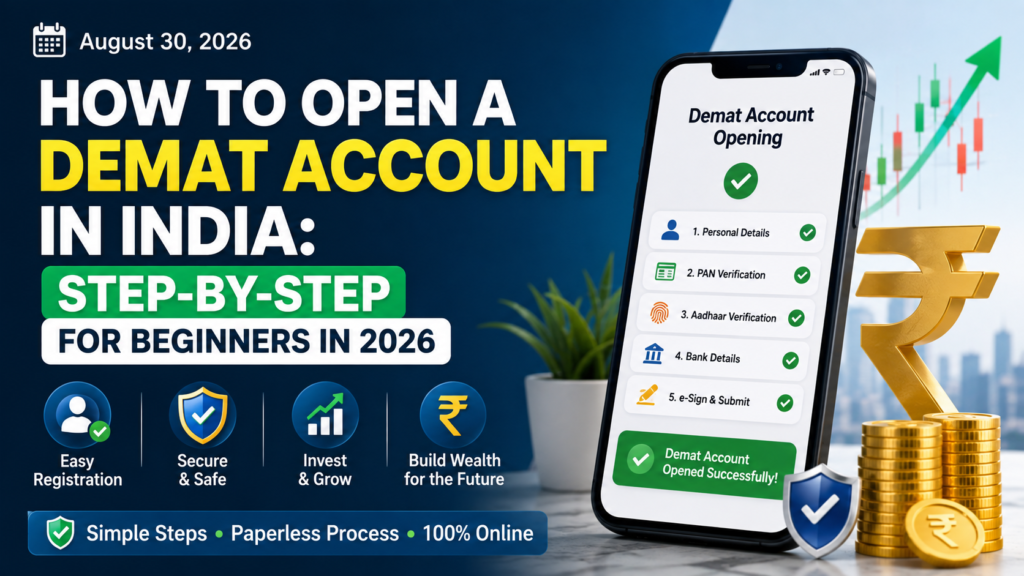
How to Open a Demat Account in India: Step-by-Step for Beginners in 2026

📈 Investing & SIP
💡
Unlock Your Investing Journey
A Demat account is your first step to wealth creation.
Start Today

Many young salaried Indians tell me they want to invest, but the whole process seems too complex. They get stuck right at the beginning, just trying to figure out what a “Demat account” even means. But here is the thing: opening one is much simpler than you think. It’s your gateway to real wealth.

— Anshuman Kumar, FP&A Manager, InfoBuddy Finance

Who this guide is for: This guide is for salaried individuals in India, especially those aged 25-42, who are new to the world of investing. If you are a first-time investor from a tier 2 or 3 city looking to buy stocks, mutual funds, or ETFs, and the idea of a Demat account feels overwhelming, you are in the right place. We will break down every step, making it super simple.

Rahul is 28. He works as a marketing executive in Pune, bringing home ₹48,000 every month. He had been hearing about friends investing in the stock market and making good returns. “I want to start too,” he told me once. “But where do I even begin? What is a Demat account? Is it complicated?” He felt stuck, intimidated by the jargon. The thought of losing money also kept him from taking action. He had ₹15,000 sitting idle in his savings account. He wanted to invest it, but the whole process of opening a Demat account felt like a huge roadblock. This is a common story. Many salaried Indians like Rahul want to grow their money beyond traditional savings, but the initial steps, like opening a Demat account, seem like a big hurdle. Let’s make it easy for you.

Why You Need a Demat Account to Invest in India

You cannot buy or sell shares, mutual funds, or exchange-traded funds (ETFs) directly in India without a Demat account. Think of a Demat account as your digital locker for holding securities. Just like your bank account holds your money, your Demat account holds your shares and other investments electronically. This system was introduced to eliminate physical share certificates, making transactions faster, safer, and fraud-free. Source: SEBI — Verified August 2026

Demat vs. Trading Account: What’s the Difference?

People often confuse Demat and trading accounts. A Demat account holds your shares. A trading account is what you use to place buy and sell orders in the stock market. You need both to actively trade or invest. Your trading account acts as the interface between your bank account and your Demat account. When you buy shares, money moves from your bank to the trading account, and shares move into your Demat account. When you sell, the reverse happens.
Key Documents for Demat Account Opening (KYC Norms)
Proof of Identity (PoI)
PAN Card (Mandatory)
Proof of Address (PoA)
Aadhaar Card, Passport, Driving License, Utility Bill (latest 3 months)
Proof of Income (PoI – for derivatives)
Bank statement (last 6 months), ITR acknowledgement, Salary Slip
Bank Account Proof
Canceled Cheque, Bank Statement
Source: SEBI Master Circular — Verified August 2026

Your Step-by-Step Guide to Opening a Demat Account in 2026

Opening a Demat account is a straightforward process today, mostly done online. Here is how you can do it:
1
Choose a Depository Participant (DP)

A Depository Participant (DP) is an agent of a Depository (like NSDL or CDSL). Stockbrokers, banks, and non-banking financial companies (NBFCs) can be DPs. Some popular DPs include Zerodha, Upstox, Groww, ICICI Direct, HDFC Securities. Compare their charges, customer service, and platform ease of use.

2
Fill the Application Form

Most DPs offer a completely online application. You will fill out personal details, bank details, and nominee information. Ensure all details match your KYC documents. This typically takes 10-15 minutes.

3
Complete Your KYC (Know Your Customer)

This is where you upload the required documents (PAN, Aadhaar, bank proof, etc.). Many DPs allow for Video KYC (IPV – In-Person Verification) where you complete the verification process via a video call with a representative. Keep your original documents handy during this step.

4
E-Sign the Agreement

After document verification, you will electronically sign the client agreement using your Aadhaar. This legalizes your application. It is quick and paperless.

5
Receive Your Demat Account Details

Once your application is processed and approved (usually within 24-48 hours), you will receive your Demat Account Number (a 16-digit number) and client ID via email. You are now ready to start investing!

Understanding Demat Account Charges

While opening a Demat account might be free with some DPs, there are usually some charges involved that you should be aware of.
Account Opening Fees: Many DPs offer zero account opening fees as a promotional offer. Still, confirm this before proceeding.
💡
Annual Maintenance Charges (AMC): Most DPs charge an annual fee for maintaining your Demat account, ranging from ₹300 to ₹800 per year. Some offer a lifetime free AMC if you meet certain criteria.
⚠️
Transaction Charges: These are levied when you buy or sell shares. They include brokerage fees, STT (Securities Transaction Tax), transaction charges (NSE/BSE), GST, and stamp duty. Brokerage can be a flat fee (e.g., ₹20 per trade) or a percentage (e.g., 0.05%). These add up, so compare carefully.
Rahul’s Investing Journey

Remember Rahul from Pune? After our chat, he decided to take the plunge. He spent an hour comparing two DPs online and chose one with a zero account opening fee and low annual maintenance charges. He gathered his PAN card, Aadhaar, and a cancelled cheque. The entire online application process, including video KYC, took him about 30 minutes. Two days later, his Demat account was active. He then started a small SIP of ₹2,500 in an index fund through his trading account. “It felt like a big deal before,” he told me, “but it was actually so easy. Now I feel like I am finally taking control of my money.” That initial hesitation of ₹15,000 has now become a regular, disciplined investment. In fact, he found a mutual fund where he could invest his initial ₹15,000 as a lump sum.

Demat Account Do’s and Don’ts for Beginners

Do’s ✅
✓ Compare DPs and their charges before choosing.
✓ Link your primary bank account for seamless transactions.
✓ Keep your KYC details updated with your DP.
✓ Opt for a nominee to ensure smooth asset transfer in the future.
✓ Review your Demat statement regularly for any discrepancies.
Don’ts ❌
✗ Share your Demat account login credentials or OTP with anyone.
✗ Jump into complex derivatives (futures & options) without proper knowledge.
✗ Ignore your annual statements – they tell you what holdings you have.
✗ Fall for unsolicited calls promising guaranteed high returns.
✗ Use multiple Demat accounts unnecessarily, as each might have AMC.

Your Next Step — Do This Today

Ready to start your investing journey? Here is what you can do right now:
1
Research Depository Participants (Takes 5 minutes)

Visit the websites of a few popular DPs like Zerodha (zerodha.com), Upstox (upstox.com), or Groww (groww.in). Compare their account opening fees, AMC, and brokerage charges for equity delivery. Many offer free account opening.

2
Gather Your Documents (Takes 2 minutes)

Ensure you have digital copies of your PAN Card, Aadhaar Card, a cancelled cheque, and your latest bank statement ready. Having these handy will speed up the application process.

3
Start Your Online Application (Takes 10 minutes)

Pick your preferred DP and begin the online application. Follow the on-screen instructions. You can complete the initial steps quickly and resume later if needed.

Frequently Asked Questions About Demat Accounts

1. What exactly is a Demat account?
A Demat (dematerialized) account holds your shares and securities in an electronic format, just like a bank account holds your money. It eliminates the need for physical share certificates.
2. Why do I need a Demat account to invest in the stock market?
SEBI regulations make it mandatory to have a Demat account to buy or sell shares, mutual funds, ETFs, and other securities in India. It ensures transparent and secure transactions.
3. What is a Depository Participant (DP)?
A DP is an intermediary between you and the depository (NSDL or CDSL). Stockbrokers, banks, and NBFCs act as DPs. You open your Demat account with a DP.
4. Are there any charges for a Demat account?
While account opening can often be free, DPs usually charge an Annual Maintenance Charge (AMC) and transaction fees (brokerage, taxes). These vary, so compare DPs.
5. What documents are required to open a Demat account?
You will need your PAN card (mandatory), Aadhaar card or other proof of address, bank account proof (like a cancelled cheque), and sometimes proof of income (for derivative trading).
6. Can I open multiple Demat accounts?
Yes, you can open multiple Demat accounts with different DPs. However, each account might incur Annual Maintenance Charges, so it’s often simpler to manage one or two.

Opening a Demat account is not a complex task; it is a fundamental step towards building your financial future. Do not let initial confusion hold you back. Start small, understand the process, and you will be well on your way to becoming a confident investor. Your journey to financial independence often begins with simple, well-informed actions like this. So, take that first step today and get your Demat account sorted. You have got this!

Share this guide with a friend:
Twitter
AK
Anshuman Kumar
FP&A Manager, InfoBuddy Finance
Anshuman Kumar is an FP&A Manager with over a decade of experience in financial planning, taxation, and payroll. An MBA in Finance, he writes for InfoBuddy Finance, simplifying complex financial topics for salaried Indians and first-time investors based on real-world experiences.
This article is for informational and educational purposes only. It does not constitute financial advice, investment advice, or tax advice. The examples and numbers used are illustrative and may not reflect your personal situation. Please consult a qualified financial advisor or tax professional for advice specific to your circumstances. InfoBuddy Finance is not a SEBI-registered investment advisor.

Leave a Comment

Your email address will not be published. Required fields are marked *

Scroll to Top