
Many salaried individuals just accept their TDS deductions without truly understanding them. But by being proactive and knowing the rules, you can significantly reduce the tax deducted from your salary, ensuring more money stays in your pocket every month.
— Anshuman Kumar, FP&A ManagerYou work hard, earn your salary, and then you see a chunk deducted as “TDS” on your payslip. Does it make you wonder what exactly TDS is, why it’s deducted, and if you can do anything to reduce it? You’re not alone. Many salaried employees find TDS confusing.
However, understanding TDS (Tax Deducted at Source) is simpler than it seems. It’s basically a system where tax is deducted from your income at the very point it is paid to you. For salaried individuals, this means your employer deducts a portion of your salary as tax and deposits it with the government.
What is TDS for Salaried Employees?
TDS, or Tax Deducted at Source, is an advance payment of income tax. The government mandates that certain payers, like your employer, deduct tax when they make payments like your salary. This helps the government collect tax throughout the year, rather than waiting until the financial year ends.
For salaried employees, your employer is responsible for deducting TDS from your monthly salary. They calculate your estimated annual income tax liability and then deduct a proportionate amount each month. Furthermore, this deducted amount is then deposited to the Income Tax Department on your behalf.
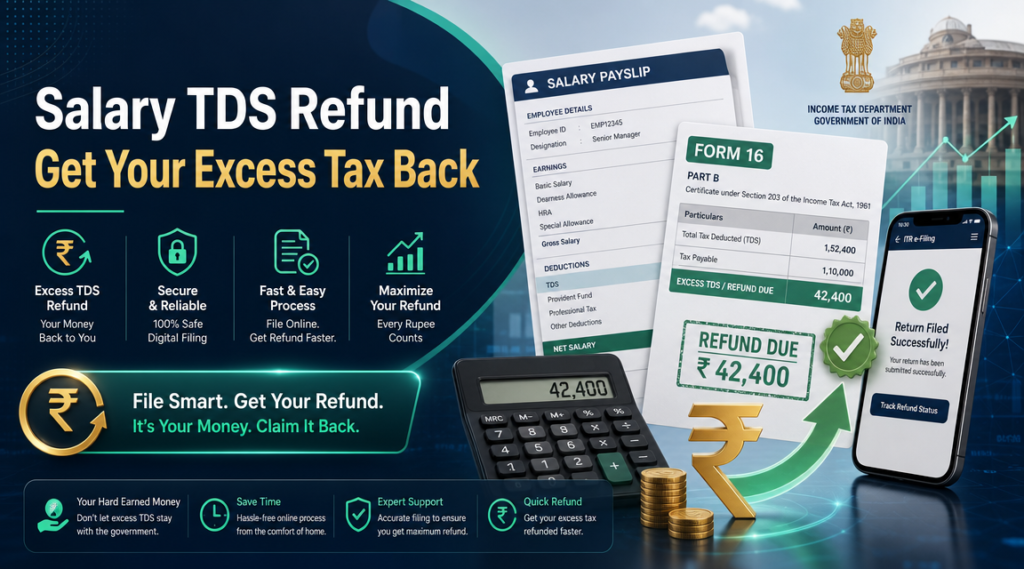
Eventually, when you file your Income Tax Return (ITR), the total TDS deducted from your salary is adjusted against your final tax liability. If more tax was deducted than required, you’ll get a refund. Conversely, if less was deducted, you might need to pay the balance.
How is TDS Calculated on Your Salary?
Your employer doesn’t just guess your TDS. They follow a specific calculation process based on current income tax laws. In fact, understanding this process is crucial for managing your tax efficiently.
Here’s a simplified breakdown:
Deleted:- Estimate Gross Annual Income: Your employer first estimates your total salary components for the entire financial year (April to March), including basic pay, HRA, special allowances, bonus, etc.
- Factor in Exemptions: Certain parts of your salary are exempt from tax, like House Rent Allowance (HRA) or Leave Travel Allowance (LTA), subject to conditions. Your employer will consider these.
- Consider Deductions (Form 12BB): This is where you come in. You need to declare your planned investments and expenses (like those under Section 80C, 80D, home loan interest, etc.) to your employer using Form 12BB. Your employer subtracts these from your taxable income.
- Calculate Taxable Income: After reducing exemptions and deductions from your gross annual income, your employer arrives at your estimated taxable income.
- Apply Tax Slabs: The income tax slabs (old or new regime, depending on your choice) are applied to your taxable income to determine your total annual tax liability.
- Deduct Monthly TDS: Your total annual tax liability is then divided by 12 (or the remaining months in the financial year) to arrive at the monthly TDS amount to be deducted.
Smart Ways to Reduce Your TDS Deduction
Now that you know how TDS is calculated, let’s explore practical ways to reduce the TDS deducted from your salary. The goal is to lower your taxable income, which in turn reduces your overall tax liability and hence, your TDS.
Investing up to ₹1.5 lakh in instruments like Public Provident Fund (PPF), Employee Provident Fund (EPF), ELSS mutual funds, life insurance premiums, and Sukanya Samriddhi Yojana can significantly reduce your taxable income. For instance, ensure you submit proof of these investments to your employer.
Explore Section 80C Tax Saving GuideIf you live in a rented accommodation, you can claim House Rent Allowance (HRA) exemption. The actual exemption depends on your salary, HRA received, and rent paid. Providing rent receipts and your landlord’s PAN (if rent exceeds ₹1 lakh annually) to your employer is necessary.
Understand HRA Exemption CalculationIf you have a home loan, you can claim a deduction of up to ₹2 lakh on the interest paid for a self-occupied property under Section 24(b). This can substantially reduce your taxable income. Remember to provide your home loan interest certificate to your employer.
Real Story — How Ritu from Bengaluru Saved on TDS
Ritu, a 28-year-old software engineer in Bengaluru, earns ₹10 LPA. For the first few months of FY 2025-26, her employer was deducting ₹6,000 as TDS monthly. This was based on her estimated income without considering her planned investments. However, Ritu decided to be proactive.
She declared her plans to invest ₹1.5 lakh in ELSS for Section 80C, ₹25,000 for health insurance (Section 80D), and claimed HRA exemption by submitting rent receipts for ₹20,000/month. As a result of these declarations, her taxable income reduced significantly.
Her employer adjusted the TDS deduction. From the next month, her monthly TDS dropped to ₹3,500. This meant an extra ₹2,500 in her hand every month, amounting to a saving of ₹22,500 over the remaining 9 months of the financial year. By taking control of her TDS for salaried employees, Ritu ensured she wasn’t overpaying tax.
Understanding Form 16 & Checking Your TDS Credit
Form 16 is a critical document provided by your employer. It certifies the details of your salary and the TDS deducted from it. Part A of Form 16 provides details of TDS deducted and deposited. Part B contains details of your salary break-up, exemptions, and deductions.
You should cross-verify the TDS mentioned in your Form 16 with Form 26AS. Form 26AS is your consolidated annual tax statement from the Income Tax Department. It shows all taxes deposited against your PAN. It’s essential to ensure that your employer has accurately deposited the TDS deducted from your salary. If there’s a mismatch, contact your employer immediately to rectify it.
Your Guide to ITR Filing 2025-26Frequently Asked Questions About TDS for Salaried Employees
Managing your TDS for salaried employees effectively is not about avoiding tax, but about paying the right amount of tax at the right time. By proactively understanding the rules, declaring your investments, and verifying your deductions, you can ensure that your salary deductions are accurate.
Take charge of your finances. A little effort in understanding TDS can lead to significant savings and peace of mind. Remember, knowledge is power when it comes to your money.